What Standard of Cleaning Does a Medical Centre Actually Need And Who Is Responsible for It?

TL;DR: Medical centres in Sydney must meet ACSQHC Standard 3 (Preventing and Controlling Infections) and RACGP Criterion C7.1, which require daily cleaning of waiting rooms, between-patient disinfection of consulting surfaces, and the use of TGA-listed hospital-grade disinfectants. Practice managers hold duty of care under WHS Act 2011 NSW, even when cleaning is outsourced. Mercy Property Care provides specialist medical facility cleaning services across Western Sydney, with trained staff, documented cleaning schedules, and TGA-compliant products — ready for RACGP accreditation review.

If you manage a GP clinic, specialist suite, or allied health practice, you already know that keeping the space looking clean is the easy part. What is harder to navigate is understanding exactly what standard your cleaning actually needs to reach, and whether the company you hired is genuinely meeting it.

Medical facility cleaning services operate under a different set of rules than standard commercial cleaning. The threshold is higher, the products are different, and the consequences of getting it wrong go beyond a bad review. This guide walks through what the standards say, what that looks like in practice, and what questions to ask your cleaning provider before your next RACGP accreditation check.

What cleaning standard applies to a GP clinic or medical centre in Sydney?

The national benchmark for any accredited GP clinic or day surgery in Australia is ACSQHC Standard 3, published by the Australian Commission on Safety and Quality in Health Care. This standard specifically covers the prevention and control of healthcare-associated infections, and it applies to every practice seeking RACGP accreditation.

At the practice level, RACGP Criterion C7.1 translates Standard 3 into day-to-day requirements: cleaning schedules must be documented, products must be appropriate for the infection risk level of each zone, and staff, whether in-house or outsourced cleaners, must be trained in infection control protocols.

On top of that, NSW Health’s Infection Prevention and Control Policy (PD2017_013) applies to all public and private health facilities operating in New South Wales, including small private practices. It is not just for hospitals.

The short version: a medical centre needs cleaning that can be audited and verified, not just cleaning that looks good on the day.

What is the difference between “clean” and “disinfected” in a healthcare setting?

This is one of the most commonly misunderstood points for practice managers working with general commercial cleaners.

“Clean” means the visible removal of dirt, dust, and debris. “Disinfected” means reducing the microbial load on a surface to a level that is safe for a healthcare environment. The NHMRC’s 2019 Australian Guidelines for the Prevention and Control of Infection in Healthcare are clear that high-touch surfaces in clinical areas require disinfection, not just cleaning.

A surface can look spotless and still carry infectious material. That is the reason the guidelines specify dwell times for disinfectant products, the chemical needs time on the surface to work, and why TGA registration of the product actually matters.

What areas of a medical centre need the most attention?

Not every area of a clinic carries the same infection risk, and the cleaning approach should reflect that.

High-priority areas (requiring daily or between-patient disinfection): consulting room benches, examination tables, door handles and push plates, light switches, EFTPOS terminals, chairs in waiting rooms, and reception desk surfaces.

Standard daily cleaning: bathrooms, floors throughout, general waiting area furniture, and staff kitchen surfaces.

Weekly deep clean: low-touch areas including skirting boards, window ledges, behind furniture, and air vent covers. AS/NZS 4187:2014 references environmental cleaning near reusable medical device storage areas — worth checking if your practice stores any clinical equipment in shared spaces.

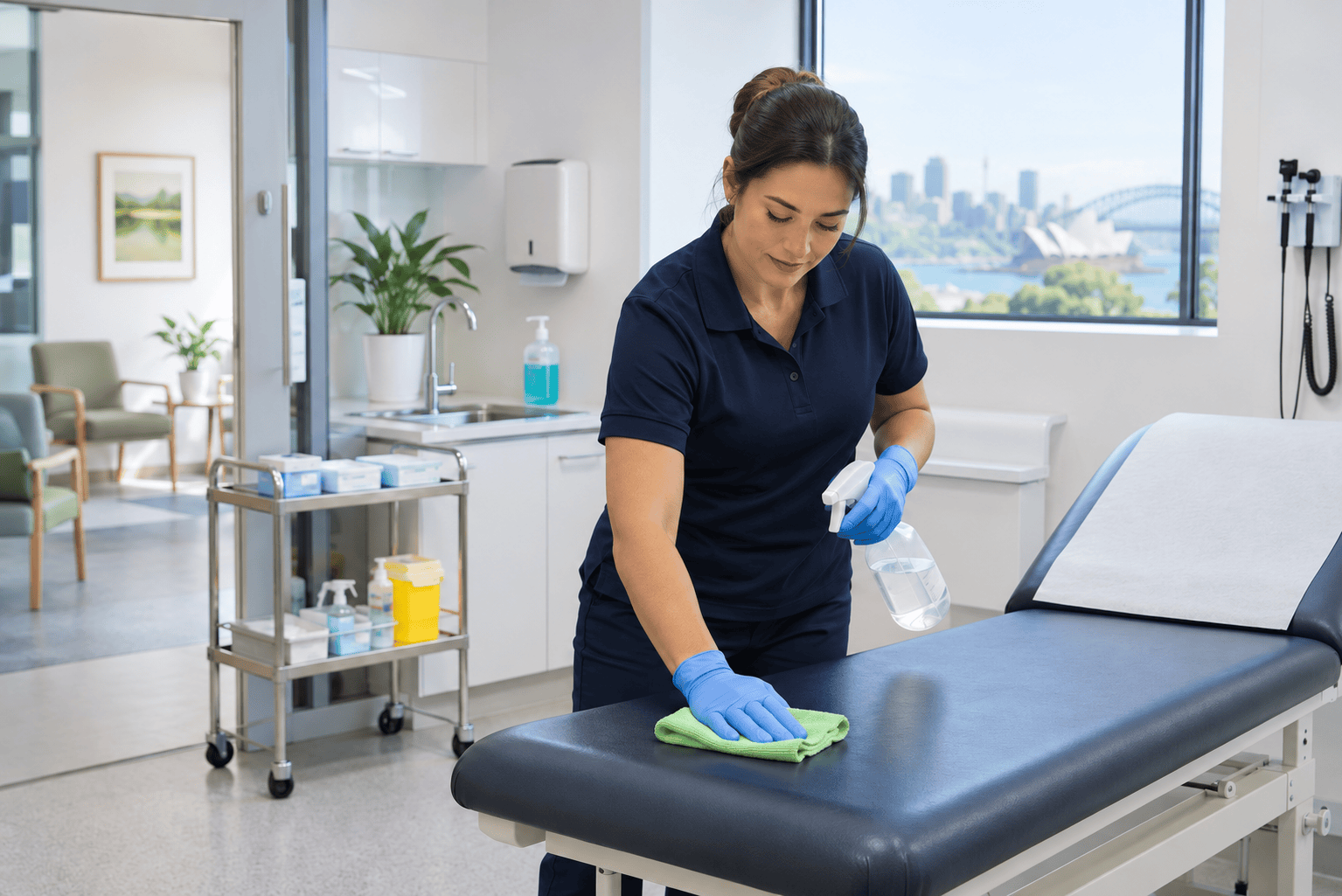
The consulting room is where standards catch practices out most often. Between patients, the examination table and any high-touch surfaces in the room need to be wiped with a TGA-listed disinfectant. If your cleaner only comes in after hours, you need a documented protocol for who handles that during the day.

What products should be used when cleaning a medical centre?

Products used in a healthcare cleaning context must be TGA-listed disinfectants, registered with the Therapeutic Goods Administration for use as hard-surface disinfectants in health settings. This is not optional for practices seeking RACGP accreditation.

Hospital-grade disinfectants are the standard minimum. The product label needs to specify the contact time (dwell time) required to achieve the claimed disinfection level. A cleaner who sprays and immediately wipes is not following the protocol, regardless of which product they use.

If your current cleaning provider cannot tell you the TGA registration number of the disinfectant they use in your consulting rooms, that is worth following up before your next accreditation review.

How often does a medical centre need to be cleaned?

Under RACGP Criterion C7.1, cleaning frequency must match the infection risk level of each zone in the practice.

As a baseline: waiting rooms and bathrooms need a full clean every day the practice is open. Consulting rooms need between-patient surface disinfection throughout the day, plus a full daily clean at the end of sessions. Low-touch areas and storage rooms require a documented weekly clean.

What the RACGP assessors look for is not just that the cleaning happened, they look for the written schedule and the sign-off log confirming it did. If your cleaning company does not provide a documented schedule with records you can keep on file, that is a gap in your compliance system.

Who is actually responsible for infection control cleaning at a medical centre?

The practice manager or principal GP carries duty of care under the WHS Act 2011 NSW for the safety of the workplace — for both staff and patients. That duty does not transfer to your cleaning company when you outsource.

What outsourcing does give you is operational capability, a trained team, the right products, and documented processes. But the practice still needs to verify that the service meets Standard 3, and keep records showing it does.

This is why choosing a cleaning company that understands RACGP requirements — and provides scheduling documentation you can file — matters a lot more than choosing one based on price alone. Mercy Property Care works with medical centres across Western Sydney and provides written cleaning schedules and product records as standard, so your practice documentation is always accreditation-ready.

If you want to see how this works in practice before you commit, you can book a free site assessment for your clinic or medical practice — the team will walk through your space and map it against the relevant cleaning standards.

What should you look for when choosing medical facility cleaning services in Sydney?

There are four things worth checking before you sign with any provider:

First, ask whether their staff have completed infection control training specific to healthcare environments. General commercial cleaning training is not the same thing.

Second, ask for the TGA registration details of the disinfectants they use in clinical areas.

Third, ask whether they provide a documented cleaning schedule and sign-off log that you can keep for your RACGP records.

Fourth, check whether they have experience with GP clinics or specialist practices, not just offices. The cleaning protocols are meaningfully different.

Mercy Property Care’s medical facility cleaning services in Sydney cover all of these points. The team is familiar with the RACGP accreditation process, uses TGA-listed products throughout, and provides written schedules as standard. If you want to understand what’s involved in the medical centre cleaning costs in Sydney, we break that down clearly with no obligation.

FAQ

Q: Does a GP clinic need a different type of cleaner to a regular office?
Yes. A GP clinic requires staff trained in infection control, TGA-listed hospital-grade disinfectants with correct dwell times, and documented cleaning schedules that meet ACSQHC Standard 3 and RACGP Criterion C7.1. A standard commercial cleaner working to office specifications will not meet those requirements.

Q: What is ACSQHC Standard 3 and does it apply to my practice?
ACSQHC Standard 3 covers the prevention and control of healthcare-associated infections and applies to all health service organisations seeking national accreditation in Australia, including GP clinics and private specialist practices. It sets the minimum requirements for infection control procedures, surface cleaning, and documentation.

Q: How do I prove my cleaning meets RACGP accreditation requirements?
The RACGP assessors look for a written cleaning schedule, records showing when cleaning was completed, the products used (including TGA registration details), and evidence of staff training. Your cleaning provider should be supplying these records as part of their service. If they are not, ask for them specifically.

Q: Can the same cleaner do both the office areas and clinical rooms in a medical centre?
Yes, but only if they have been trained in both commercial cleaning and healthcare-specific infection control protocols. The products and procedures in clinical areas are different from what is used in reception or staff rooms. The cleaner needs to know which protocol applies to which zone and switch between them correctly.

Keeping a medical centre clean to the standard it actually needs is not complicated once you know what the framework looks like. The ACSQHC Standard 3, RACGP Criterion C7.1, and NSW Health’s infection control policy give you a clear picture of what “good” means — and a cleaning company that knows those standards can make the whole process straightforward.

Book a free site assessment for your medical centre or GP clinic in Western Sydney and the Mercy Property Care team will walk through your space, map it against the relevant standards, and set up a cleaning schedule that keeps your practice accreditation-ready year-round. You can also reach us through the commercial cleaning services page if you want to compare what we offer across different facility types.

Written by Mercy Property Care, Medical Centre and Commercial Cleaning Specialists, Western Sydney

What Infection Control Standards Should a Medical Centre Cleaner in Sydney Actually Meet?

TL;DR

Medical centre cleaning in Sydney must comply with the NHMRC Australian Guidelines for the Prevention and Control of Infection in Healthcare (2019) and NSW Health Infection Control Policy. Cleaning teams must use TGA-listed hospital-grade disinfectants, operate colour-coded equipment to prevent cross-contamination between clinical zones, and maintain documented terminal and routine cleaning schedules. A compliant provider should carry at least $10 million in public liability insurance, have PPE-trained staff, and be able to produce ATP testing records or written verification logs. A standard office cleaner does not meet these requirements.

Choosing a cleaner for a GP clinic, dental practice, or allied health centre is a different decision from choosing one for an office. The infection control requirements are different, the products are different, and the consequences of getting it wrong are in a completely different category when patients are involved.

Most Sydney cleaning companies list “medical centre cleaning” on their website. Far fewer can tell you what TGA registration number is on their disinfectant label, what dwell time that product needs before wiping, or what their colour-coded zone protocol looks like. This article covers what the Australian standards actually require, what questions to ask before you hire anyone, and what a properly structured cleaning contract for a healthcare facility should include.

What makes medical centre cleaning different from office cleaning?

The core difference is infection risk. Medical centres are environments where pathogens move between sick patients, treatment surfaces, shared waiting areas, and staff workspaces constantly. Healthcare-associated infections (HAIs) are a documented patient safety risk, and the way a facility is cleaned is one of the primary controls against them.

The NHMRC Australian Guidelines for the Prevention and Control of Infection in Healthcare (2019) set the national benchmark. These guidelines apply to all healthcare facilities in Australia, including GP clinics, dental surgeries, pathology collection points, physiotherapy and allied health practices, and specialist suites. NSW Health’s Infection Control Policy sits alongside these guidelines with additional obligations for facilities operating in New South Wales.

A regular commercial cleaner uses general-purpose multi-surface products and a standard mop rotation. A medical centre cleaner needs TGA-listed hospital-grade disinfectants applied at correct dilutions, a colour-coded equipment system, separate cleaning processes for clinical and non-clinical zones, and written records that can be reviewed at an accreditation audit.

What products does a medical centre cleaner have to use?

Every disinfectant used in a healthcare environment must be listed on the Therapeutic Goods Administration (TGA) register as a hospital-grade disinfectant. The TGA registration number should appear on the product label. If a cleaner cannot show you the label and point to the registration number, you do not know what they are putting on your clinical surfaces.

Under NHMRC guidelines, the basic product framework for a medical centre looks like this:

  • Neutral detergent for general surface preparation before disinfection (cleaning removes visible soiling first)
  • TGA-listed hospital-grade disinfectant for all high-touch surfaces, including door handles, light switches, chairs, desks, and bathroom fixtures
  • Sporicidal disinfectant for areas with higher contamination risk, such as bathrooms, clinical waste contact surfaces, and procedure rooms where indicated
  • Products applied at the correct dilution ratio and left for the full manufacturer-specified contact time before wiping

That last point matters more than most people realise. Many disinfectants require a contact time of 30 seconds to 10 minutes to be effective. Spraying and wiping immediately achieves very little in terms of actual pathogen kill. A trained medical centre cleaner knows the dwell time for each product in their kit and follows it.

What is a colour-coded cleaning system and why does it matter?

A colour-coded system assigns specific colours to specific tools. Each colour of cloth, mop head, glove, and bucket stays in its designated zone and never crosses into another. This is how you prevent pathogens from the patient bathroom ending up on the waiting room chair or the reception desk.

The standard zone breakdown used in Australian healthcare facilities looks like this:

  • Red: Toilets, bathrooms, clinical waste contact areas
  • Blue: General areas including waiting rooms, corridors, and administrative offices
  • Yellow: Clinical treatment rooms and procedure areas
  • Green: Food preparation and kitchen areas

If a cleaning company cannot describe their colour-coded system clearly, and explain how staff are trained and monitored on it, they are not set up for medical centre work. Ask the question directly before you commit to a contract.

What is terminal cleaning and when does a clinic need it?

Routine cleaning is the daily maintenance of surfaces between patient appointments. Terminal cleaning is the thorough clean-down of a clinical space at the end of the day, after a procedure room has been used, or following any situation where the room needs to be returned to a safe clinical standard.

Terminal cleaning in a medical setting covers:

  • All horizontal surfaces from floor level to the highest reachable point, including equipment tops, shelving, and overhead storage
  • All high-touch points throughout the room, not just the obvious ones
  • Floors mopped with a fresh mop head specific to that room, not shared with adjoining spaces
  • Soft furnishings, chair arms, and curtains checked and wiped or flagged for laundering
  • Clinical waste bins sanitised after emptying, not just lined and left

A cleaning provider that handles medical facilities should list routine and terminal cleaning as separate service items in their agreement, with different frequency schedules and different product protocols. If your quote only mentions one type of cleaning, push for clarification.

How do you verify that a medical centre has actually been cleaned properly?

ATP (Adenosine Triphosphate) testing is the standard verification method used in Australian healthcare environments. A swab is taken from a surface after cleaning, then tested with a device called a luminometer. The reading tells you whether any biological residue remains. A high reading means the clean was not effective.

Not every cleaning company uses ATP testing, but those that do are operating at a higher standard and can provide written results. This matters for AGPAL and QIP practice accreditation, where cleaning verification records can be requested during an audit. If your practice is approaching accreditation, ask any prospective cleaner whether they test and document, and whether they can provide historical records.

What should a medical centre cleaning contract actually include?

A cleaning contract for a healthcare facility needs more detail than a standard commercial agreement. Before you sign anything, check that the contract covers:

  • A cleaning schedule broken down by zone, cleaning type (routine vs terminal), and frequency
  • The specific products being used, with their TGA registration numbers listed
  • A written confirmation of the colour-coded zone protocol
  • Staff infection control training requirements and who is responsible for maintaining them
  • PPE minimums per zone, including glove type, mask requirements, and apron use
  • Public liability insurance of at least $10 million, with a current certificate of currency available on request
  • Police-checked and security-cleared staff, particularly for after-hours access
  • A documentation process that supports practice accreditation requirements
  • A written escalation process for contamination incidents, spills, or a cleaning failure

If a quote does not address most of these points, it was written for a standard commercial job. Ask for a revised scope that is specific to your healthcare environment before proceeding.

How Mercy Property Care approaches medical centre cleaning in Sydney

Mercy Property Care provides medical centre cleaning services across Sydney, covering GP clinics, dental practices, allied health suites, and specialist facilities in Western Sydney and surrounding areas. Their teams use TGA-listed hospital-grade disinfectants, follow documented colour-coded zone protocols, and can provide cleaning records aligned with AGPAL and QIP accreditation requirements.

For practices managing multiple site types, including office-based staff areas alongside clinical rooms, Mercy Property Care’s broader commercial cleaning services in Sydney can be structured to cover both. For practices that also provide support to NDIS participants, their NDIS cleaning service in Sydney handles those obligations separately and to the applicable NDIS Quality and Safeguards Commission standards.

FAQ

Q: Can a standard commercial cleaning company clean a medical centre in Sydney?

A: Most standard commercial cleaners are not equipped for it. Medical centre cleaning requires TGA-listed disinfectants used at the correct dilution and dwell time, colour-coded equipment protocols by zone, and knowledge of NHMRC infection control guidelines. A cleaner without this training creates a genuine infection risk for patients and puts your practice at risk during accreditation.

Q: What disinfectants are required for GP clinic cleaning?

A: All disinfectants must be TGA-listed as hospital-grade. They need to be applied at the correct concentration and left for the manufacturer’s specified contact time before wiping. Common active ingredients include quaternary ammonium compounds, accelerated hydrogen peroxide, and sodium hypochlorite, with the specific product depending on the surface type and zone risk level.

Q: How often should a medical centre be cleaned?

A: GP clinics and allied health centres typically need daily routine cleaning of all patient-contact surfaces, with terminal cleaning of treatment rooms at the end of each clinical day. High-traffic bathrooms generally require multiple cleans per day. The right schedule depends on your patient volume, room turnover, and the nature of procedures carried out on site, and it should be written into your cleaning agreement.

Q: What does infection control cleaning cost for a Sydney medical centre?

A: For a small GP clinic or allied health practice, a compliant clean typically ranges from $180 to $350 per session depending on floor area, number of clinical rooms, and whether terminal cleaning is included. Mercy Property Care provides obligation-free site assessments and can build a pricing structure around your specific layout and schedule.

Q: Does a medical centre cleaning company need special insurance?

A: Yes. Any cleaning provider working in a clinical environment should carry public liability insurance of at least $10 million. Always ask for the current certificate of currency, not just a verbal confirmation, before signing a contract.

Getting medical centre cleaning right comes down to three things: the right products used correctly, a team that has been trained in infection control protocols, and documentation your practice can put in front of an auditor without hesitation. Most cleaning companies in Sydney are set up for offices and strata. A medical centre is a different environment with different obligations, and the contract should reflect that. Mercy Property Care works with Sydney clinics to build cleaning schedules that match clinical zones, patient flow, and accreditation requirements. Contact Mercy Property Care for a no-obligation site assessment.

Written by Mercy Property Care, Medical and Commercial Cleaning Specialists, Sydney

Need Something To Be Cleaned?

Mercy Property Care Team Will Come To The Rescue!

Please fill out this form and we will get back to you shortly.