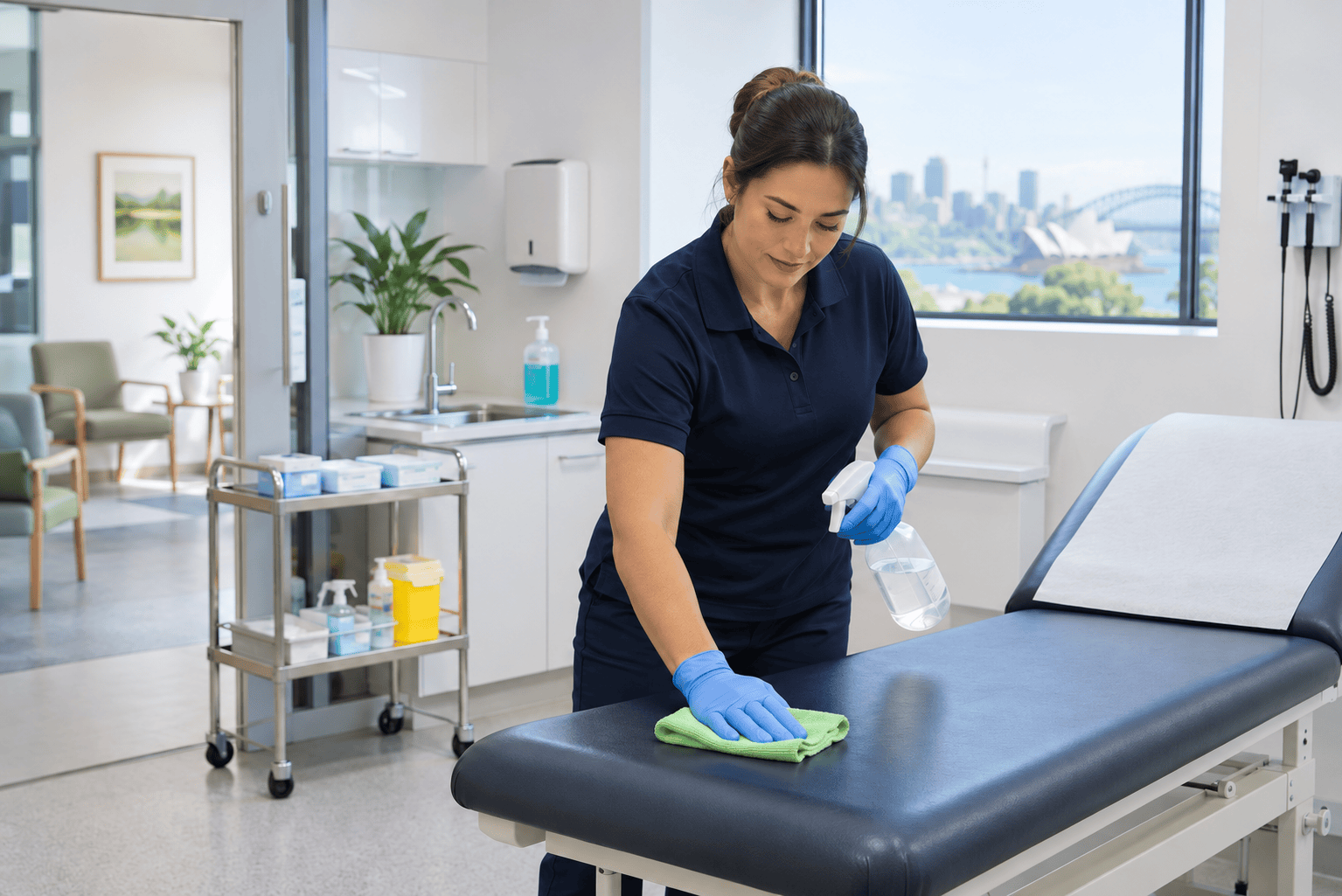
What Standard of Cleaning Does a Medical Centre Actually Need And Who Is Responsible for It?

TL;DR: Medical centres in Sydney must meet ACSQHC Standard 3 (Preventing and Controlling Infections) and RACGP Criterion C7.1, which require daily cleaning of waiting rooms, between-patient disinfection of consulting surfaces, and the use of TGA-listed hospital-grade disinfectants. Practice managers hold duty of care under WHS Act 2011 NSW, even when cleaning is outsourced. Mercy Property Care provides specialist medical facility cleaning services across Western Sydney, with trained staff, documented cleaning schedules, and TGA-compliant products — ready for RACGP accreditation review.

If you manage a GP clinic, specialist suite, or allied health practice, you already know that keeping the space looking clean is the easy part. What is harder to navigate is understanding exactly what standard your cleaning actually needs to reach, and whether the company you hired is genuinely meeting it.

Medical facility cleaning services operate under a different set of rules than standard commercial cleaning. The threshold is higher, the products are different, and the consequences of getting it wrong go beyond a bad review. This guide walks through what the standards say, what that looks like in practice, and what questions to ask your cleaning provider before your next RACGP accreditation check.

What cleaning standard applies to a GP clinic or medical centre in Sydney?

The national benchmark for any accredited GP clinic or day surgery in Australia is ACSQHC Standard 3, published by the Australian Commission on Safety and Quality in Health Care. This standard specifically covers the prevention and control of healthcare-associated infections, and it applies to every practice seeking RACGP accreditation.

At the practice level, RACGP Criterion C7.1 translates Standard 3 into day-to-day requirements: cleaning schedules must be documented, products must be appropriate for the infection risk level of each zone, and staff, whether in-house or outsourced cleaners, must be trained in infection control protocols.

On top of that, NSW Health’s Infection Prevention and Control Policy (PD2017_013) applies to all public and private health facilities operating in New South Wales, including small private practices. It is not just for hospitals.

The short version: a medical centre needs cleaning that can be audited and verified, not just cleaning that looks good on the day.

What is the difference between “clean” and “disinfected” in a healthcare setting?

This is one of the most commonly misunderstood points for practice managers working with general commercial cleaners.

“Clean” means the visible removal of dirt, dust, and debris. “Disinfected” means reducing the microbial load on a surface to a level that is safe for a healthcare environment. The NHMRC’s 2019 Australian Guidelines for the Prevention and Control of Infection in Healthcare are clear that high-touch surfaces in clinical areas require disinfection, not just cleaning.

A surface can look spotless and still carry infectious material. That is the reason the guidelines specify dwell times for disinfectant products, the chemical needs time on the surface to work, and why TGA registration of the product actually matters.

What areas of a medical centre need the most attention?

Not every area of a clinic carries the same infection risk, and the cleaning approach should reflect that.

High-priority areas (requiring daily or between-patient disinfection): consulting room benches, examination tables, door handles and push plates, light switches, EFTPOS terminals, chairs in waiting rooms, and reception desk surfaces.

Standard daily cleaning: bathrooms, floors throughout, general waiting area furniture, and staff kitchen surfaces.

Weekly deep clean: low-touch areas including skirting boards, window ledges, behind furniture, and air vent covers. AS/NZS 4187:2014 references environmental cleaning near reusable medical device storage areas — worth checking if your practice stores any clinical equipment in shared spaces.

The consulting room is where standards catch practices out most often. Between patients, the examination table and any high-touch surfaces in the room need to be wiped with a TGA-listed disinfectant. If your cleaner only comes in after hours, you need a documented protocol for who handles that during the day.

What products should be used when cleaning a medical centre?

Products used in a healthcare cleaning context must be TGA-listed disinfectants, registered with the Therapeutic Goods Administration for use as hard-surface disinfectants in health settings. This is not optional for practices seeking RACGP accreditation.

Hospital-grade disinfectants are the standard minimum. The product label needs to specify the contact time (dwell time) required to achieve the claimed disinfection level. A cleaner who sprays and immediately wipes is not following the protocol, regardless of which product they use.

If your current cleaning provider cannot tell you the TGA registration number of the disinfectant they use in your consulting rooms, that is worth following up before your next accreditation review.

How often does a medical centre need to be cleaned?

Under RACGP Criterion C7.1, cleaning frequency must match the infection risk level of each zone in the practice.

As a baseline: waiting rooms and bathrooms need a full clean every day the practice is open. Consulting rooms need between-patient surface disinfection throughout the day, plus a full daily clean at the end of sessions. Low-touch areas and storage rooms require a documented weekly clean.

What the RACGP assessors look for is not just that the cleaning happened, they look for the written schedule and the sign-off log confirming it did. If your cleaning company does not provide a documented schedule with records you can keep on file, that is a gap in your compliance system.

Who is actually responsible for infection control cleaning at a medical centre?

The practice manager or principal GP carries duty of care under the WHS Act 2011 NSW for the safety of the workplace — for both staff and patients. That duty does not transfer to your cleaning company when you outsource.

What outsourcing does give you is operational capability, a trained team, the right products, and documented processes. But the practice still needs to verify that the service meets Standard 3, and keep records showing it does.

This is why choosing a cleaning company that understands RACGP requirements — and provides scheduling documentation you can file — matters a lot more than choosing one based on price alone. Mercy Property Care works with medical centres across Western Sydney and provides written cleaning schedules and product records as standard, so your practice documentation is always accreditation-ready.

If you want to see how this works in practice before you commit, you can book a free site assessment for your clinic or medical practice — the team will walk through your space and map it against the relevant cleaning standards.

What should you look for when choosing medical facility cleaning services in Sydney?

There are four things worth checking before you sign with any provider:

First, ask whether their staff have completed infection control training specific to healthcare environments. General commercial cleaning training is not the same thing.

Second, ask for the TGA registration details of the disinfectants they use in clinical areas.

Third, ask whether they provide a documented cleaning schedule and sign-off log that you can keep for your RACGP records.

Fourth, check whether they have experience with GP clinics or specialist practices, not just offices. The cleaning protocols are meaningfully different.

Mercy Property Care’s medical facility cleaning services in Sydney cover all of these points. The team is familiar with the RACGP accreditation process, uses TGA-listed products throughout, and provides written schedules as standard. If you want to understand what’s involved in the medical centre cleaning costs in Sydney, we break that down clearly with no obligation.

FAQ

Q: Does a GP clinic need a different type of cleaner to a regular office?
Yes. A GP clinic requires staff trained in infection control, TGA-listed hospital-grade disinfectants with correct dwell times, and documented cleaning schedules that meet ACSQHC Standard 3 and RACGP Criterion C7.1. A standard commercial cleaner working to office specifications will not meet those requirements.

Q: What is ACSQHC Standard 3 and does it apply to my practice?
ACSQHC Standard 3 covers the prevention and control of healthcare-associated infections and applies to all health service organisations seeking national accreditation in Australia, including GP clinics and private specialist practices. It sets the minimum requirements for infection control procedures, surface cleaning, and documentation.

Q: How do I prove my cleaning meets RACGP accreditation requirements?
The RACGP assessors look for a written cleaning schedule, records showing when cleaning was completed, the products used (including TGA registration details), and evidence of staff training. Your cleaning provider should be supplying these records as part of their service. If they are not, ask for them specifically.

Q: Can the same cleaner do both the office areas and clinical rooms in a medical centre?
Yes, but only if they have been trained in both commercial cleaning and healthcare-specific infection control protocols. The products and procedures in clinical areas are different from what is used in reception or staff rooms. The cleaner needs to know which protocol applies to which zone and switch between them correctly.

Keeping a medical centre clean to the standard it actually needs is not complicated once you know what the framework looks like. The ACSQHC Standard 3, RACGP Criterion C7.1, and NSW Health’s infection control policy give you a clear picture of what “good” means — and a cleaning company that knows those standards can make the whole process straightforward.

Book a free site assessment for your medical centre or GP clinic in Western Sydney and the Mercy Property Care team will walk through your space, map it against the relevant standards, and set up a cleaning schedule that keeps your practice accreditation-ready year-round. You can also reach us through the commercial cleaning services page if you want to compare what we offer across different facility types.

Written by Mercy Property Care, Medical Centre and Commercial Cleaning Specialists, Western Sydney
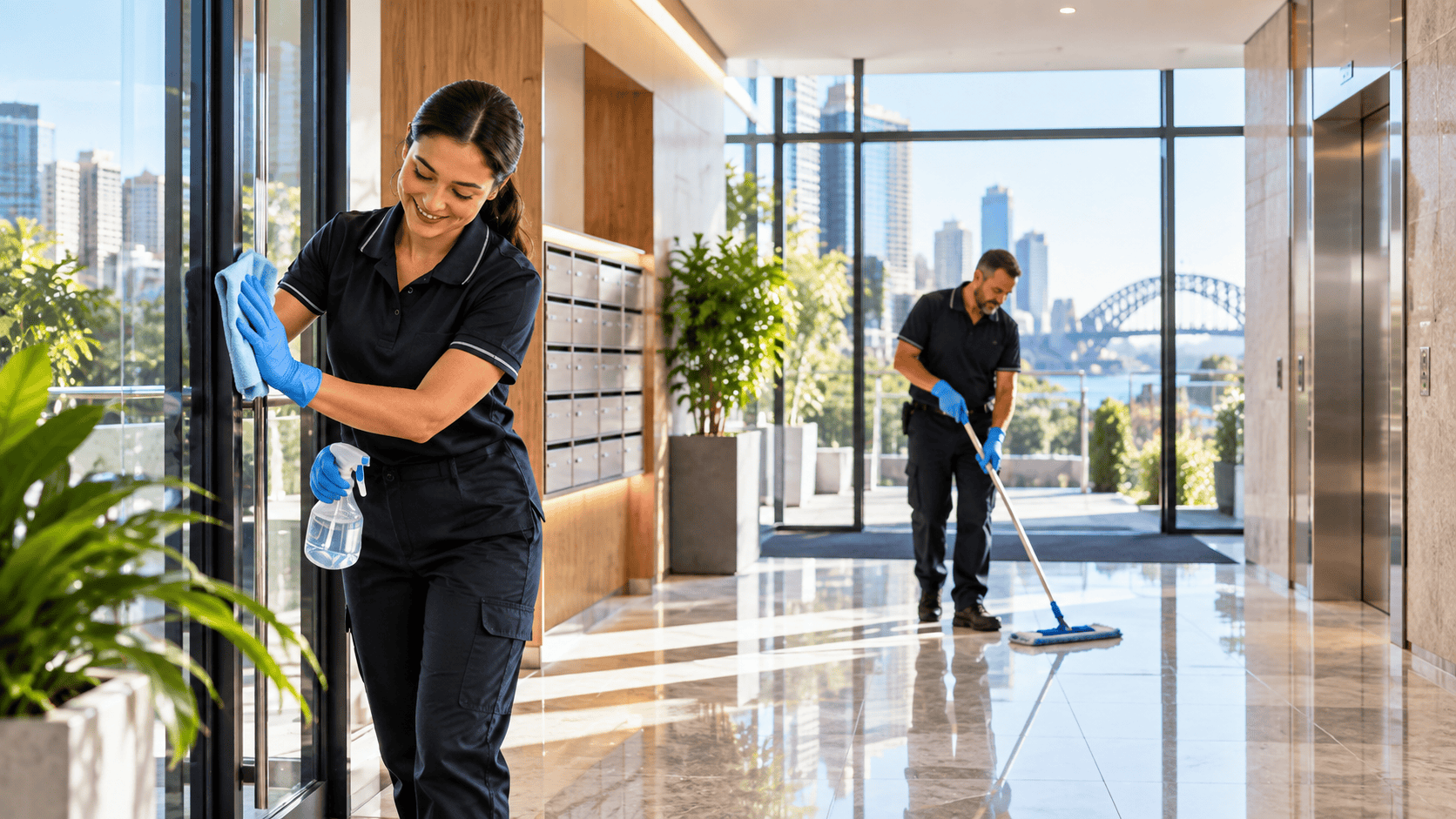
What Does Strata Cleaning Include And Who Is Actually Responsible for It in Sydney?

TL;DR :
Strata cleaning covers all common property in a residential or commercial building, lobbies, lifts, stairwells, bin rooms, car parks, and shared outdoor areas. Under the Strata Schemes Management Act 2015 NSW, the owners corporation is legally responsible for maintaining common property to a reasonable standard. In Western Sydney buildings, most owners corporations schedule professional cleaning 3 to 5 times per week depending on building size. Mercy Property Care provides written records after every visit and covers Parramatta, Blacktown, Penrith, and Castle Hill.

If you manage a strata building in Sydney and you are heading into your AGM, one of the questions that comes up almost every year is this: what exactly is the cleaner supposed to be doing, and are we paying for the right scope? It is a fair question, and the answer depends on your building type, your scheme rules, and what the Strata Schemes Management Act 2015 NSW actually requires of your owners corporation. This guide covers the basics in plain language so you can walk into that meeting knowing what to ask.

What areas does strata cleaning actually cover?

Strata cleaning covers all common property, the areas that belong to the owners corporation rather than individual lot owners. That includes every space a resident or visitor passes through that is not inside a private apartment or tenancy.

In a typical Sydney residential building, that means:

  • Entry lobbies and reception areas
  • Lift interiors, buttons, handrails, and door tracks
  • All stairwells and fire escape landings
  • Car park floors, columns, and painted line areas
  • Bin rooms and waste compactor surrounds
  • Mail and parcel areas
  • Garden edges and paths adjacent to common entrances
  • Pool surrounds, gym common areas, and shared BBQ zones (where applicable)
  • External signage, letter boxes, and intercom panels

Commercial strata buildings add loading dock areas, shared bathroom facilities, fire stair corridors between tenancies, and sometimes roof access points depending on the scheme.

The one thing strata cleaning does not cover is anything inside a private lot. That boundary matters because it affects both the scope of work and who pays for it.

How often should strata common areas be professionally cleaned?

There is no single legal frequency set out in the Strata Schemes Management Act 2015 NSW, but owners corporations do have an obligation to keep common property in a reasonable state of repair and cleanliness. In practice, most Sydney building managers translate that into a cleaning schedule based on building size and resident numbers.

Building Type Standard Frequency October to February (Summer)
Small block (under 20 lots) 2x per week 3x per week
Medium residential (20–60 lots) 3x per week 4–5x per week
Large residential (60+ lots) 5x per week Daily
Commercial strata Daily Daily + mid-week bin room focus
Mixed use (retail + residential) Daily Daily + entry mat replacement

Summer foot traffic in Western Sydney buildings increases significantly from October through February. More people using the lift, more dust brought in through lobbies, and bin rooms filling faster all push towards a higher cleaning frequency than what might work in winter. If your current contract was written in June, it is worth reviewing it before December.

Who is legally responsible for strata cleaning in NSW?

The owners corporation is responsible. Under the Strata Schemes Management Act 2015 NSW, the owners corporation must properly maintain and keep in good repair the common property of the strata scheme. Cleanliness of shared areas falls squarely within that obligation.

The strata manager, if the scheme has appointed one, coordinates that responsibility on behalf of the owners corporation, but the legal duty stays with the owners corporation itself. Individual lot owners are not responsible for cleaning common areas unless the scheme’s by-laws specifically assign a shared area to a particular lot.

What this means practically: if a resident makes a complaint to NSW Fair Trading about unclean common property and you cannot produce cleaning records showing the work was done, you are exposed. That is why a written post-service record from your cleaner matters more than most strata managers realise.

What should a strata cleaning checklist actually include?

A professional strata clean covers more than a quick vacuum of the lobby carpet. Here is what should be completed on every scheduled visit and what gets added in the summer months.

Every visit:

  • Lobby floors swept and mopped with TGA-listed disinfectant
  • Lift interior mopped, mirrored surfaces wiped, buttons and handrails sanitised
  • All stairwells swept and spot mopped
  • Bin room hosed or swept and odour-treated
  • High-touch surfaces hit: door handles, intercom buttons, letterbox areas
  • Car park entrance swept

Added from October to February:

  • HVAC vent covers in common corridors dusted (relevant under AS/NZS 3666, the standard covering biological contamination in air handling systems)
  • Entry mats deep-cleaned or replaced more frequently
  • Lift door tracks cleared of summer dust and grit build-up
  • Garden-adjacent lobby areas swept more frequently due to increased foot traffic

Mercy Property Care provides a written post-service record after every visit confirming what was cleaned, what products were used, and anything flagged for follow-up. For strata managers preparing for levy disputes, insurance claims, or NSW Fair Trading complaints, that documentation can be genuinely useful.

What should I look for when hiring a strata cleaning company in Sydney?

The basics are non-negotiable: the cleaner should carry at least $20M public liability insurance, use police-checked staff, and provide written records after every visit. Most strata managers are surprised how many operators do not do all three.

Beyond that, worth asking:

  • Do they adjust their scope and frequency for summer without needing to be asked?
  • Can they service the full building, lobby, car park, bin room, pool surround, or just the internal corridors?
  • Do they use TGA-listed disinfectants on shared touch points, or general-purpose cleaning products?
  • Are they familiar with the Strata Schemes Management Act 2015 NSW and what “reasonable maintenance” actually means for common property?

If you are in Parramatta, Blacktown, Penrith, Castle Hill, or anywhere across Western Sydney, you can see exactly what a professional strata cleaning service in Sydney covers, get an honest picture of commercial cleaning costs for strata buildings, or book a free site assessment for your building before your next AGM.

FAQ

Q: What is included in a strata clean in Sydney?
A: A professional strata clean covers all common property areas: lobbies, lifts, stairwells, bin rooms, car parks, mail areas, and shared outdoor spaces. It does not include anything inside a private lot. Under the Strata Schemes Management Act 2015 NSW, the owners corporation is responsible for keeping all common property in a clean and reasonable condition. A proper strata cleaner will provide written records after every visit confirming what was done.

Q: How often should a strata building be professionally cleaned?
A: It depends on building size and foot traffic. A small block under 20 lots can typically manage with 2 to 3 professional cleans per week. A large residential building with 60 or more lots usually needs daily cleaning. During Sydney’s summer months from October through February, most buildings should increase their frequency by at least one additional visit per week to manage the higher foot traffic and dust brought into lobbies and stairwells.

Q: Who pays for strata cleaning, the owners corporation or individual owners?
A: The owners corporation pays for strata cleaning from the administrative fund, which is funded by lot owner levies. Individual lot owners are not separately invoiced for common area cleaning. The strata manager typically organises and pays the cleaner on behalf of the owners corporation. If your levies are covering cleaning costs but the work is not being documented, ask your strata manager for written service records.

Q: Does Mercy Property Care handle strata cleaning across Western Sydney?
A: Yes. Mercy Property Care provides strata cleaning services across Parramatta, Blacktown, Penrith, Castle Hill, Seven Hills, and surrounding Western Sydney suburbs. Every clean includes a written post-service record, police-checked staff, TGA-listed disinfectants, and $20M public liability insurance. You can book a free building assessment before committing to a contract.

Getting strata cleaning right is mostly about knowing what the scope should be, making sure it is documented, and working with someone who understands both the building type and the legal obligations that sit behind it. If your AGM is coming up or your current contract is due for review, speaking with Mercy Property Care before you sign anything is a good starting point. Book a free site assessment here and get a proper recommendation for your building before summer arrives.

Written by Mercy Property Care, Strata and Commercial Cleaning Specialists, Western Sydney
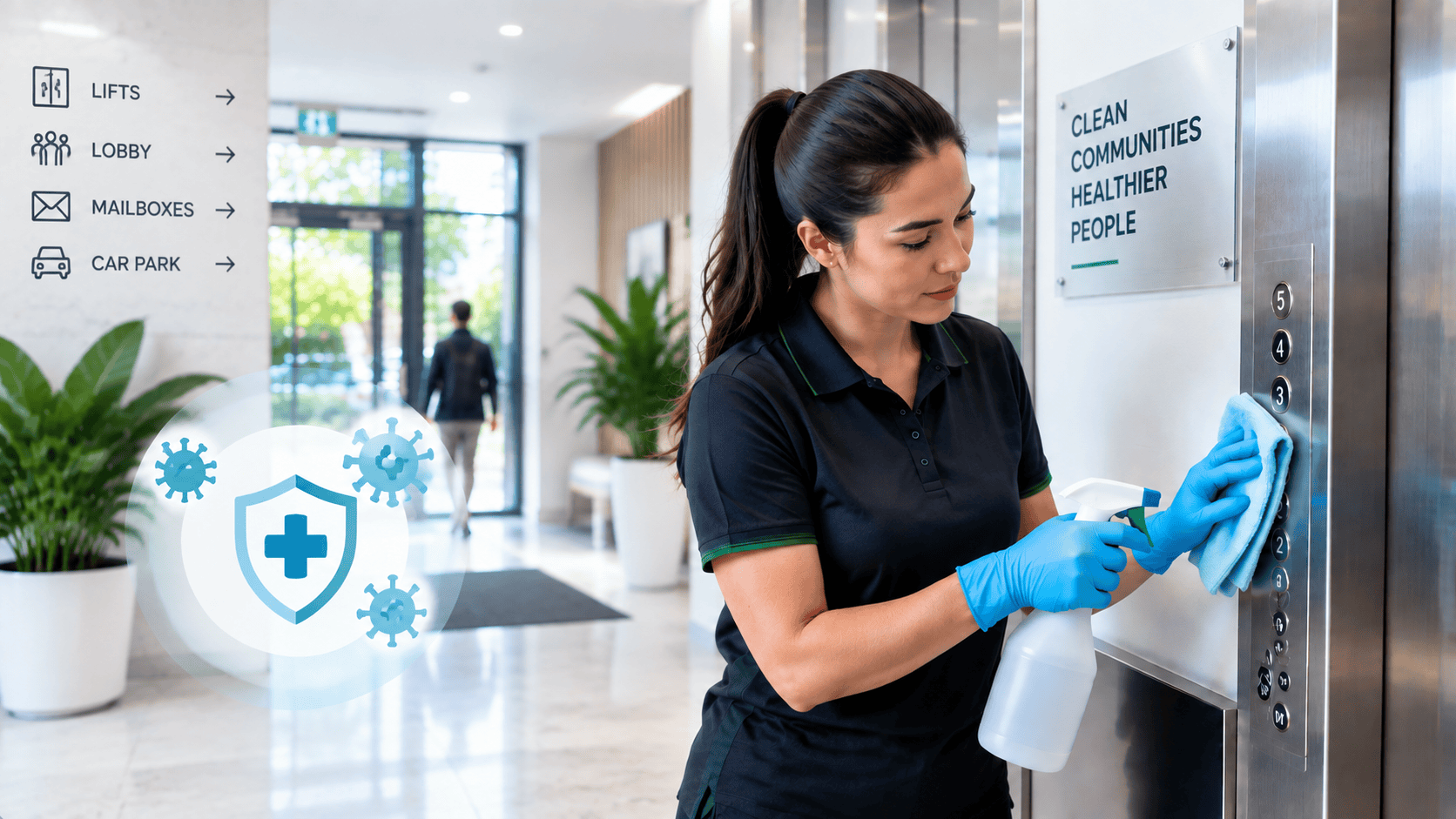
Strata Cleaning Sydney, What Owners Corporations Must Demand from Their Cleaner in 2026

TL;DR

NSW strata law changed in April 2026. Owners corporations now need standard-format 10-year capital works fund plans, and building managers carry expanded maintenance duties under the updated NSW Strata Schemes Management Act 2015. For strata cleaning in Sydney, this means one thing practically: your cleaning provider must give you written records after every visit, not just show up and clean. Mercy Property Care provides compliant strata cleaning across Western Sydney with documented service records, consistent teams, and same-week availability.

Why strata cleaning in Sydney just got more complicated

Strata cleaning in Sydney has always needed more structure than a handshake and a monthly invoice. But since April 2026, the stakes for getting it wrong have increased.

Under reforms to the NSW Strata Schemes Management Act 2015, all owners corporations must now maintain 10-year capital works fund plans in a government-prescribed standard format. Those plans need to account for ongoing maintenance across the building, including common areas, lobbies, car parks, and shared amenities. Separately, building managers now carry expanded duties around safety and maintenance that came into effect in October 2025.

None of this creates new cleaning obligations overnight. But it does mean that when a strata committee, building manager, or Strata Community Association NSW auditor asks what cleaning was done and when, you need actual records, not a verbal confirmation from the cleaner who was here last Thursday.

A well-structured strata cleaning contract gives your committee exactly that. A poorly structured one leaves a gap in your capital works documentation that is awkward to explain.

What does strata cleaning actually cover in a Sydney building?

Strata cleaning covers the common areas that all residents and visitors use. These are the spaces that accumulate wear fastest and matter most to building presentation, resident satisfaction, and safety.

For most Sydney strata buildings, a proper strata cleaning program covers:

  • Building entrance and lobby: floors, glass panels, letterboxes, intercom surfaces, signage
  • Lifts: interior panels, buttons, flooring, ceiling vents, and door tracks
  • Stairwells and corridors on every level, including light fittings and handrails
  • Car parks: sweeping, line marking maintenance, drain covers, waste removal
  • Outdoor common areas: bin enclosures, garden path edges, pool surrounds where applicable
  • Gyms and shared amenity rooms: surface wipe-down, equipment areas, bathroom fixtures

Frequency matters. A lobby cleaned once a week in a 40-apartment building with residents coming and going daily is not being maintained, it is being reset. The right schedule depends on resident count, foot traffic, and building type.

How often should a Sydney strata building be professionally cleaned?

For most Western Sydney strata buildings in suburbs like Parramatta, Penrith, Blacktown, and the Hills District, a workable baseline looks like this:

Area Minimum frequency
Building lobby and entry 3 to 5 times per week
Lifts 3 to 5 times per week
Stairwells and corridors Weekly
Car park Fortnightly
Bin room Weekly
Gym or amenity room 2 to 3 times per week

Spring is the right moment to revisit this. Building committees that skipped an autumn or winter deep clean now have compacted lobby floors, lift interiors that need a proper wipe-down, and common bathroom grout that has darkened. October through November is the scheduling window before Christmas locks out contractor availability.

What should you ask a strata cleaning company before signing a contract?

This is where most strata managers discover whether a provider is set up for strata work or just handles offices and homes on the side.

Four questions that tell you what you need to know:

Do you provide written service records after every visit? This is the single most important question. A strata cleaning company working in Sydney should provide a post-service record specifying what was cleaned, which areas were covered, the products used, and the date. If they cannot do this as standard, they are not operating at the level your capital works plan documentation requires.

Can you give me a written scope of work before we start? You should know exactly what is being cleaned at what frequency before any money changes hands. A verbal scope is not a scope.

What Australian Standards do you work to for carpets and hard floors? The standard for commercial carpet cleaning is AS/NZS 3733:2021, which requires hot water extraction at 65 degrees or above. A provider who does not know this standard is probably not using it.

Do your staff hold police clearances and public liability insurance? For any building where residents live, this is a baseline. Ask to see the certificate. Minimum $20M public liability is the benchmark for strata cleaning contracts in Sydney.

Mercy Property Care provides written scope before every clean, documented service record after every visit, and carries full public liability insurance. The team services strata buildings across Western Sydney as part of the same commercial cleaning program that covers offices and medical facilities.

Does NDIS apply to strata environments?

Sometimes, and it matters when it does.

If your strata building includes residents who are NDIS participants, or if the building houses a service provider that supports participants, the NDIS Practice Standards create an additional layer of environmental cleaning obligation. Registered NDIS providers must document infection control procedures, and cleaning evidence is auditable by the NDIS Quality and Safeguards Commission.

Mercy Property Care holds NDIS registration and provides NDIS cleaning services in Sydney separately from strata contracts. For mixed-use buildings where participants reside or receive services on-site, both the strata and participant cleaning can be structured under one provider relationship, which reduces the administrative overhead for support coordinators and building managers.

Frequently Asked Questions

Q: What is strata cleaning in Sydney and what does it include?

Strata cleaning in Sydney covers the common areas of residential or commercial strata buildings: lobbies, lifts, stairwells, corridors, car parks, bin rooms, and shared amenity spaces. It is distinct from individual unit or apartment cleaning. A professional strata cleaning company provides written service records after every visit, which are important for owners corporation documentation and capital works fund plan records under NSW strata law.

Q: How often should a strata building in Sydney be cleaned?

For most Sydney strata buildings, high-traffic areas like lobbies and lifts need cleaning three to five times per week. Stairwells and corridors work on a weekly schedule. Car parks are typically fortnightly. The right frequency depends on your building’s resident count, foot traffic, and any shared amenity spaces like gyms. A site assessment from a professional strata cleaning company gives you a schedule that matches the actual use of your building rather than a generic template.

Q: Do I need written service records from my strata cleaner?

Yes. From April 2026, NSW owners’ corporations must maintain 10-year capital works fund plans in a standard prescribed format. Cleaning is part of ongoing building maintenance, and documented service records are the evidence that maintenance was carried out. If your current strata cleaning provider does not supply written records after every visit, you have a gap in your compliance documentation. Ask your provider directly.

Q: How much does strata cleaning cost in Sydney in 2026?

Cost depends on building size, the number of common areas, access requirements, and how often cleaning occurs. For a small residential strata building under 20 apartments, a typical professional clean runs in the range of $150 to $350 per visit. Larger buildings with car parks, gyms, and multiple lift cores are scoped individually. Any provider quoting without a site inspection is guessing. Mercy Property Care provides free site assessments and written quotes before any contract is agreed.

Q: Can Mercy Property Care clean our strata building in Western Sydney?

Yes. Mercy Property Care provides strata cleaning services across Western Sydney including Parramatta, Westmead, Blacktown, Penrith, Castle Hill, the Hills District, and surrounding suburbs. Every clean includes a written service record. After-hours access is available to work around resident movements and building management requirements. Call 1300 973 856 to arrange a free site assessment.

Get strata cleaning that works for your building and your committee

Choosing the right strata cleaning company in Sydney comes down to documentation, consistency, and whether the provider actually understands what a strata environment requires. A residential building is not an office. A lobby used by 80 residents needs a different approach than a meeting room used once a week.

Mercy Property Care provides strata cleaning services across Western Sydney with written scope before every engagement, service records after every visit, and consistent teams who know your building. Spring scheduling is open now, before the pre-Christmas window closes.

Call: 1300 973 856

Or: 0257 407 688

Based in Toongabbie. Servicing Parramatta, Westmead, Blacktown, Penrith, Castle Hill, the Hills District, and all of Western Sydney.

Written by Mercy Property Care, Commercial and Strata Cleaning Specialists, Western Sydney.

What Infection Control Standards Should a Medical Centre Cleaner in Sydney Actually Meet?

TL;DR

Medical centre cleaning in Sydney must comply with the NHMRC Australian Guidelines for the Prevention and Control of Infection in Healthcare (2019) and NSW Health Infection Control Policy. Cleaning teams must use TGA-listed hospital-grade disinfectants, operate colour-coded equipment to prevent cross-contamination between clinical zones, and maintain documented terminal and routine cleaning schedules. A compliant provider should carry at least $10 million in public liability insurance, have PPE-trained staff, and be able to produce ATP testing records or written verification logs. A standard office cleaner does not meet these requirements.

Choosing a cleaner for a GP clinic, dental practice, or allied health centre is a different decision from choosing one for an office. The infection control requirements are different, the products are different, and the consequences of getting it wrong are in a completely different category when patients are involved.

Most Sydney cleaning companies list “medical centre cleaning” on their website. Far fewer can tell you what TGA registration number is on their disinfectant label, what dwell time that product needs before wiping, or what their colour-coded zone protocol looks like. This article covers what the Australian standards actually require, what questions to ask before you hire anyone, and what a properly structured cleaning contract for a healthcare facility should include.

What makes medical centre cleaning different from office cleaning?

The core difference is infection risk. Medical centres are environments where pathogens move between sick patients, treatment surfaces, shared waiting areas, and staff workspaces constantly. Healthcare-associated infections (HAIs) are a documented patient safety risk, and the way a facility is cleaned is one of the primary controls against them.

The NHMRC Australian Guidelines for the Prevention and Control of Infection in Healthcare (2019) set the national benchmark. These guidelines apply to all healthcare facilities in Australia, including GP clinics, dental surgeries, pathology collection points, physiotherapy and allied health practices, and specialist suites. NSW Health’s Infection Control Policy sits alongside these guidelines with additional obligations for facilities operating in New South Wales.

A regular commercial cleaner uses general-purpose multi-surface products and a standard mop rotation. A medical centre cleaner needs TGA-listed hospital-grade disinfectants applied at correct dilutions, a colour-coded equipment system, separate cleaning processes for clinical and non-clinical zones, and written records that can be reviewed at an accreditation audit.

What products does a medical centre cleaner have to use?

Every disinfectant used in a healthcare environment must be listed on the Therapeutic Goods Administration (TGA) register as a hospital-grade disinfectant. The TGA registration number should appear on the product label. If a cleaner cannot show you the label and point to the registration number, you do not know what they are putting on your clinical surfaces.

Under NHMRC guidelines, the basic product framework for a medical centre looks like this:

  • Neutral detergent for general surface preparation before disinfection (cleaning removes visible soiling first)
  • TGA-listed hospital-grade disinfectant for all high-touch surfaces, including door handles, light switches, chairs, desks, and bathroom fixtures
  • Sporicidal disinfectant for areas with higher contamination risk, such as bathrooms, clinical waste contact surfaces, and procedure rooms where indicated
  • Products applied at the correct dilution ratio and left for the full manufacturer-specified contact time before wiping

That last point matters more than most people realise. Many disinfectants require a contact time of 30 seconds to 10 minutes to be effective. Spraying and wiping immediately achieves very little in terms of actual pathogen kill. A trained medical centre cleaner knows the dwell time for each product in their kit and follows it.

What is a colour-coded cleaning system and why does it matter?

A colour-coded system assigns specific colours to specific tools. Each colour of cloth, mop head, glove, and bucket stays in its designated zone and never crosses into another. This is how you prevent pathogens from the patient bathroom ending up on the waiting room chair or the reception desk.

The standard zone breakdown used in Australian healthcare facilities looks like this:

  • Red: Toilets, bathrooms, clinical waste contact areas
  • Blue: General areas including waiting rooms, corridors, and administrative offices
  • Yellow: Clinical treatment rooms and procedure areas
  • Green: Food preparation and kitchen areas

If a cleaning company cannot describe their colour-coded system clearly, and explain how staff are trained and monitored on it, they are not set up for medical centre work. Ask the question directly before you commit to a contract.

What is terminal cleaning and when does a clinic need it?

Routine cleaning is the daily maintenance of surfaces between patient appointments. Terminal cleaning is the thorough clean-down of a clinical space at the end of the day, after a procedure room has been used, or following any situation where the room needs to be returned to a safe clinical standard.

Terminal cleaning in a medical setting covers:

  • All horizontal surfaces from floor level to the highest reachable point, including equipment tops, shelving, and overhead storage
  • All high-touch points throughout the room, not just the obvious ones
  • Floors mopped with a fresh mop head specific to that room, not shared with adjoining spaces
  • Soft furnishings, chair arms, and curtains checked and wiped or flagged for laundering
  • Clinical waste bins sanitised after emptying, not just lined and left

A cleaning provider that handles medical facilities should list routine and terminal cleaning as separate service items in their agreement, with different frequency schedules and different product protocols. If your quote only mentions one type of cleaning, push for clarification.

How do you verify that a medical centre has actually been cleaned properly?

ATP (Adenosine Triphosphate) testing is the standard verification method used in Australian healthcare environments. A swab is taken from a surface after cleaning, then tested with a device called a luminometer. The reading tells you whether any biological residue remains. A high reading means the clean was not effective.

Not every cleaning company uses ATP testing, but those that do are operating at a higher standard and can provide written results. This matters for AGPAL and QIP practice accreditation, where cleaning verification records can be requested during an audit. If your practice is approaching accreditation, ask any prospective cleaner whether they test and document, and whether they can provide historical records.

What should a medical centre cleaning contract actually include?

A cleaning contract for a healthcare facility needs more detail than a standard commercial agreement. Before you sign anything, check that the contract covers:

  • A cleaning schedule broken down by zone, cleaning type (routine vs terminal), and frequency
  • The specific products being used, with their TGA registration numbers listed
  • A written confirmation of the colour-coded zone protocol
  • Staff infection control training requirements and who is responsible for maintaining them
  • PPE minimums per zone, including glove type, mask requirements, and apron use
  • Public liability insurance of at least $10 million, with a current certificate of currency available on request
  • Police-checked and security-cleared staff, particularly for after-hours access
  • A documentation process that supports practice accreditation requirements
  • A written escalation process for contamination incidents, spills, or a cleaning failure

If a quote does not address most of these points, it was written for a standard commercial job. Ask for a revised scope that is specific to your healthcare environment before proceeding.

How Mercy Property Care approaches medical centre cleaning in Sydney

Mercy Property Care provides medical centre cleaning services across Sydney, covering GP clinics, dental practices, allied health suites, and specialist facilities in Western Sydney and surrounding areas. Their teams use TGA-listed hospital-grade disinfectants, follow documented colour-coded zone protocols, and can provide cleaning records aligned with AGPAL and QIP accreditation requirements.

For practices managing multiple site types, including office-based staff areas alongside clinical rooms, Mercy Property Care’s broader commercial cleaning services in Sydney can be structured to cover both. For practices that also provide support to NDIS participants, their NDIS cleaning service in Sydney handles those obligations separately and to the applicable NDIS Quality and Safeguards Commission standards.

FAQ

Q: Can a standard commercial cleaning company clean a medical centre in Sydney?

A: Most standard commercial cleaners are not equipped for it. Medical centre cleaning requires TGA-listed disinfectants used at the correct dilution and dwell time, colour-coded equipment protocols by zone, and knowledge of NHMRC infection control guidelines. A cleaner without this training creates a genuine infection risk for patients and puts your practice at risk during accreditation.

Q: What disinfectants are required for GP clinic cleaning?

A: All disinfectants must be TGA-listed as hospital-grade. They need to be applied at the correct concentration and left for the manufacturer’s specified contact time before wiping. Common active ingredients include quaternary ammonium compounds, accelerated hydrogen peroxide, and sodium hypochlorite, with the specific product depending on the surface type and zone risk level.

Q: How often should a medical centre be cleaned?

A: GP clinics and allied health centres typically need daily routine cleaning of all patient-contact surfaces, with terminal cleaning of treatment rooms at the end of each clinical day. High-traffic bathrooms generally require multiple cleans per day. The right schedule depends on your patient volume, room turnover, and the nature of procedures carried out on site, and it should be written into your cleaning agreement.

Q: What does infection control cleaning cost for a Sydney medical centre?

A: For a small GP clinic or allied health practice, a compliant clean typically ranges from $180 to $350 per session depending on floor area, number of clinical rooms, and whether terminal cleaning is included. Mercy Property Care provides obligation-free site assessments and can build a pricing structure around your specific layout and schedule.

Q: Does a medical centre cleaning company need special insurance?

A: Yes. Any cleaning provider working in a clinical environment should carry public liability insurance of at least $10 million. Always ask for the current certificate of currency, not just a verbal confirmation, before signing a contract.

Getting medical centre cleaning right comes down to three things: the right products used correctly, a team that has been trained in infection control protocols, and documentation your practice can put in front of an auditor without hesitation. Most cleaning companies in Sydney are set up for offices and strata. A medical centre is a different environment with different obligations, and the contract should reflect that. Mercy Property Care works with Sydney clinics to build cleaning schedules that match clinical zones, patient flow, and accreditation requirements. Contact Mercy Property Care for a no-obligation site assessment.

Written by Mercy Property Care, Medical and Commercial Cleaning Specialists, Sydney

What Strata Cleaning Should Cover While NSW Flu Levels Stay High

TL;DR
Strata cleaning covers the shared parts of an apartment building, such as lifts, lobbies, handrails, bin rooms and car parks. With influenza still at a high level in NSW in September 2026, committees should add daily wipe-downs of high touch points using TGA-listed disinfectant. NSW Fair Trading can now act on owners corporations that fail to maintain common property, so a written cleaning schedule protects residents and the committee.

If you sit on a strata committee or manage a building in Western Sydney, you may have noticed more coughing in the lift lately. NSW Health’s report for the week ending 5 September 2026 shows influenza still at a high level, with RSV at a moderate level. Good strata cleaning won’t stop every bug, but it cuts how often residents share contaminated buttons and handles. Here is what it should include this spring, and what the latest strata rules mean for your building.

Key Insights

  • Flu isn’t finished. NSW Health reported influenza at a high level of activity for the week ending 5 September 2026 (NSW Health surveillance).
  • Clean first, then disinfect. Disinfectant works best on a surface that has already been cleaned, and it needs its full label contact time.
  • The legal duty is real. Under section 106 of the Strata Schemes Management Act 2015, the owners corporation must maintain and repair common property.
  • Enforcement has stepped up. NSW Fair Trading now has powers to investigate and act when that duty isn’t met (NSW Fair Trading).
  • About 1.2 million people live in NSW strata, so shared spaces touch a lot of lives.

What does strata cleaning actually include?

Strata cleaning is the regular cleaning of a building’s common property, the areas every owner shares. It doesn’t cover the inside of private lots unless an owner books that separately.

A typical strata building cleaning scope in Sydney includes lifts and lift lobbies, entry foyers and intercoms, stairwells, letterbox areas, bin rooms, car park lobbies and shared gyms or laundries. Window cleaning and pressure washing are often add-ons, so check your contract.

Why do shared building spaces matter more while flu is circulating?

Flu spreads mainly through droplets in the air, but it can also pass from a hand to a surface to the next hand. Research commonly cited by health agencies shows flu viruses can survive on hard surfaces like stainless steel and plastic for up to 24 to 48 hours.

Picture a 60-unit block in Parramatta. One resident with a cough presses the lift button, opens the foyer door and checks the letterbox. Within an hour, dozens of neighbours have touched those same spots.

Cleaning can’t replace vaccination or staying home when sick. It is, though, one of the few things a committee can directly control.

Which high touch points need extra attention in a strata building?

The surfaces touched by the most hands, most often, need the most frequent care. High touch point cleaning focuses effort where it does the most good.

Area Touch points Standard schedule Flu season schedule
Lifts Call buttons, internal panel, handrail 2 to 3 times a week Daily
Entry Door handles, push plates, intercom, fob reader 2 to 3 times a week Daily
Letterboxes Box fronts, parcel locker keypad Weekly 2 to 3 times a week
Stairwells Handrails, fire door handles Weekly 2 to 3 times a week
Shared gym Equipment grips, benches, taps 2 to 3 times a week Daily

These are starting points. A 150-unit tower in Blacktown will need more than a 12-unit walk-up.

How often should common area cleaning happen during spring?

Most Sydney buildings do well with a full common area clean two to three times a week, plus daily touch point wipe-downs while flu activity is high. Once NSW Health reports activity dropping back to low, many committees scale the daily visits down again.

Lean towards the heavier schedule for the next four to six weeks if your building has older residents, people receiving care at home, or a recent run of illness.

What do the NSW strata reforms mean for your cleaning schedule?

The reforms don’t set a cleaning frequency, but they make it more important to show that common property is being properly maintained. A written schedule and cleaning log give your committee a clear record.

  • Stronger enforcement. NSW Fair Trading can investigate owners corporations that fail to maintain common property.
  • Longer window for owners. Lot owners now have six years, up from two, to take action over a failure to repair and maintain.
  • Clearer roles. Cleaners are service providers, not building managers, so a cleaning contract doesn’t trigger building manager rules.

This is general information, not legal advice. Your strata managing agent can confirm how the rules apply to your scheme.

Due for a review? Request a strata cleaning quote from Mercy Property Care and we’ll walk the common areas with you first.

How do you choose strata cleaners you can rely on?

Reliable strata cleaners can show you their products, their safety paperwork and a record of every visit.

Before you sign, ask any provider for:

  • TGA-listed hospital-grade disinfectants, named by product
  • Safety Data Sheets and WHS procedures under the WHS Act 2011
  • Colour-coded microfibre, so bin room cloths never touch lift buttons
  • Current public liability insurance and a log of every visit

Mercy Property Care offers strata cleaning Sydney committees can check against that list. Our team also cleans medical centres and NDIS homes, so infection control habits come with them. Managing offices too? Read how offices are handling flu season hygiene.

Frequently asked questions

Q: Does strata cover cleaning inside my apartment? A: No. Strata cleaning is paid through levies and covers common property only, such as lifts, foyers, stairwells, bin rooms and car parks. If you want your apartment cleaned, book that privately, separate from the building contract.

Q: Who pays for extra cleaning during flu season? A: The owners corporation pays for common area cleaning from the administrative fund, which comes from strata levies. A committee can usually approve a short-term increase within budget, while larger ongoing changes may need owner approval, depending on the scheme’s rules.

Q: Is disinfecting the same as cleaning? A: No. Cleaning removes dirt, grease and most germs using detergent and water. Disinfecting uses a chemical, such as a TGA-listed hospital-grade disinfectant, to kill remaining germs. Disinfectant works best after a surface is cleaned and must stay on for the contact time on its label before wiping.

Q: Can Mercy Property Care clean strata buildings across Western Sydney? A: Yes. Mercy Property Care cleans strata buildings across Western Sydney, including Parramatta, Blacktown, Quakers Hill and Toongabbie. You can check the full list of suburbs we cover across Western Sydney or look at our cleaning services in Blacktown.

Ready to review your building’s cleaning?

The right strata cleaning plan depends on who uses your building and what NSW Health is reporting. With flu still high this spring, daily touch point care is a sensible step. Request a strata cleaning quote and Mercy Property Care will walk your common areas and suggest a schedule that fits your levies.

Written by Mercy Property Care, Commercial, Strata and NDIS Cleaning Specialists in Western Sydney

How to Choose a Commercial Cleaning Company in Sydney That You Can Actually Trust

TL;DR

Choosing a commercial cleaning company in Sydney comes down to four things: documented compliance, consistent staffing, a written scope before work starts, and $20M public liability insurance as a baseline. Facility managers across Western Sydney are now evaluating providers on quality assurance systems and written service records, not just price. Most cheap cleaners cannot supply a Cm3 pre-qualification certificate or post-service documentation. Mercy Property Care provides all three across Parramatta, Blacktown, Penrith, and the Hills District.

Key Insights for Facility Managers:

  • Compliance Baseline: Always verify $20M public liability insurance, Cm3 pre-qualification, and current police clearances for all staff before granting facility access.
  • Documented Scope: Insist on a written, zone-by-zone scope of work prior to contract signing to establish clear standards and accountability.
  • WHS & Audit Trail: Shift focus from low pricing to WHS documentation and post-service cleaning logs to protect against liability and audit gaps under the Work Health and Safety Act 2011.
  • Realistic Pricing: Standard office cleaning in Sydney typically ranges from $120–$200/week (under 150 sqm) to $200–$400/week (150–400 sqm). Quotes significantly below these benchmarks usually indicate a reduced cleaning scope.


There are hundreds of providers offering office cleaning in Sydney. Most have a website and a price. What most cannot give you is a written scope, a Cm3 pre-qualification, or proof the work was done after each visit. In 2026, choosing a cleaner has become a compliance decision, not just a cost one.

What should you ask a commercial cleaning company before you commit?

Do you provide a written scope of work before the contract starts? A written scope specifies every area, every task, and how often it is done. Without it, there is no agreed standard to measure performance against. A provider who cannot supply this before the first visit is not running a structured program.

Can you supply your current public liability certificate? The industry minimum for any cleaning provider in Sydney is $20M public liability insurance. Ask for the certificate, not just verbal confirmation. Any provider who says “yes we’re insured” but cannot produce a current certificate carries risk for your business if something goes wrong on your site.

Do you hold Cm3 pre-qualification or an equivalent third-party contractor verification? Cm3 is the standard contractor management system used across Australian commercial facilities to verify that a provider’s insurance, WHS compliance, and licences are current and independently checked. A provider without it requires you to take their word for their compliance status.

Do your staff hold current police clearances? For any facility where clients attend, sensitive information is stored, or NDIS participants may be present, police-cleared cleaning staff are a minimum expectation. Confirm this before access is granted.

For a full overview of what a compliant scope looks like in practice, the Mercy Property Care commercial cleaning service page outlines what is included and how site assessments work.

Why are Sydney facility managers choosing cleaners on compliance, not price?

Sydney facility managers used to select cleaning providers primarily on price. That has shifted measurably in 2026.

The Work Health and Safety Act 2011 (Safe Work Australia) places a duty of care on employers to maintain a safe work environment, and cleaning is part of that obligation. An employer who contracts a provider and cannot show they are WHS-compliant has a gap in their duty of care documentation if a workplace incident is investigated. A provider who cannot supply a cleaning log cannot prove a surface was disinfected on a specific date. In regulated sectors, that gap is a liability.

Providers operating without written scopes, service records, and verified insurance are losing contracts to those who can document everything.

What does a professional cleaning scope include for a Sydney office?

A professional scope covers six zones with confirmed frequencies in writing before work starts.

Reception and entry: Daily floor, glass, and high-touch surface cleaning. Workstations: Desk, chair, and keyboard clean 3 to 5 times per week. Kitchen: Daily bench and sink. Weekly appliance exteriors. Bathrooms: Daily clean and restock. Weekly grout maintenance. Meeting rooms: After each client-facing use, or daily for internal rooms. Common areas: Daily for high-traffic buildings, weekly for low-occupancy spaces.

For offices in Parramatta and Western Sydney, the Mercy Property Care blog covers specific guidance for local business types including medical suites, strata buildings, and NDIS provider offices.

How do you tell a reliable provider from a cheap one?

The difference becomes visible around week eight, when the kitchen rangehood is grimy and the person who gave you the quote has not responded to three messages. These are the signals that appear before you sign.

Consistent staffing. A company that names the person assigned to your site every visit is different from one that sends whoever is available.

References from comparable businesses. Ask for a reference from a facility manager in Parramatta, Blacktown, or Penrith. A provider without local references cannot confirm local reliability.

After-hours scheduling. A reliable provider includes evening or early morning access in the standard rate, not as a surcharge added after you agree to the scope.

Response time. The real test is not the first clean. It is what happens when a standard slips. A provider with a direct contact who responds within the hour is a different relationship from one who routes everything through a call centre.

For NDIS providers, the NDIS Practice Standards require documented cleaning evidence after every visit. The NDIS cleaning service page explains what this documentation includes.

How much does office cleaning cost in Sydney in 2026?

Most offices pay a fixed weekly rate. A small office under 150 sqm typically costs $120 to $200 per week. A medium office of 150 to 400 sqm runs $200 to $400 per week. A provider quoting significantly below these ranges is almost certainly reducing scope. Usually meeting room cleaning, kitchen deep maintenance, or grout care are the first things dropped.

For Parramatta-specific pricing and scope, the commercial cleaning Parramatta guide covers what local offices typically need.

Frequently Asked Questions

Q: What should I ask a cleaning provider in Sydney before signing a contract?

A: Ask for four things: a written scope before the start date, a current $20M public liability insurance certificate, Cm3 pre-qualification confirmation, and confirmation that all staff hold police clearances. A provider who cannot supply all four within 48 hours is not operating at a professional standard. These are baseline requirements in Sydney, not extras.

Q: What is the difference between a commercial cleaner and an office cleaner in Sydney?

A: Office cleaning is a subset of the broader category, which covers medical centres, strata buildings, retail spaces, and warehouses. The scope and frequency differ by building type, but both require a written specification and verified insurance before the contract starts.

Q: What is Cm3 pre-qualification and why does it matter when choosing a Sydney cleaner?

A: Cm3 is an independent contractor management platform that verifies a provider holds current insurance and WHS compliance documentation. When a cleaning company holds Cm3, a third party has verified their compliance status rather than the client having to take their word for it. For commercial tenancies and regulated environments in Sydney, Cm3 is the standard expectation.

Book a Free Commercial Cleaning Assessment in Sydney

The right cleaning arrangement for your office starts with a site assessment and a written scope, not an online form. Mercy Property Care provides free on-site assessments across Western Sydney including Parramatta, Blacktown, Penrith, and the Hills District. Every assessment includes a written scope and fixed pricing before any commitment.

Call: 1300 973 856 Or: 0257 407 688 Book online: Commercial Cleaning Services in Sydney

Based in Quakers Hill. Same-week assessments available across all Western Sydney suburbs.

Written by Mercy Property Care, Commercial Cleaning Specialists, Western Sydney.

Commercial Cleaning Parramatta — What Local Businesses Need to Know

Key Insights

  • Commercial cleaning in Parramatta costs $35–$75 per hour in 2026, with most small-to-medium offices paying $180–$380 per weekly clean
  • Parramatta is Western Sydney’s fastest-growing commercial hub — Parramatta Square, Church Street offices, and Westmead health precinct all have above-average cleaning standards
  • Frequency matters more than price: a weekly clean on a 20-person office will leave visible hygiene issues by Wednesday — most Parramatta businesses need 3× per week as a minimum
  • After-hours cleaning is standard across Parramatta Square and Church Street buildings — expect a 10–20% premium for evening or early-morning access
  • A good commercial cleaner should provide a written scope of work and fixed price before starting — not a vague hourly estimate
  • The top service types needed by Parramatta businesses: office cleaning, retail cleaning, medical centre cleaning, and strata building cleaning
  • NDIS-registered cleaners like Mercy Property Care can service both commercial premises and NDIS participant homes — reducing vendor count for operators running mixed facilities

TL;DR

Commercial cleaning in Parramatta costs $35–$75 per hour in 2026. Most Parramatta offices of 10+ staff need professional cleaning at least 3 times per week. The right provider should offer a site inspection, a written scope, and fixed pricing — not an online estimate. Mercy Property Care provides commercial cleaning services across Parramatta and all of Western Sydney, with free on-site assessments and no lock-in contracts.

What commercial cleaning services are available in Parramatta?

Parramatta has a wide range of commercial premises — from Parramatta Square office towers and Church Street retail to Westmead medical suites and Hills District business parks. A commercial cleaning company covering Parramatta should be able to handle all of them.

The most common commercial cleaning services in Parramatta include:

  • Office cleaning — daily or 3×/week depending on team size and foot traffic
  • Retail and shopfront cleaning — daily floor maintenance, glass, and high-touch surfaces
  • Medical centre cleaning — infection-control protocols, documented hygiene logs, after-hours access
  • Strata and common area cleaning — lifts, lobbies, car parks, and shared amenities
  • Deep cleans — quarterly resets or end-of-lease cleans for commercial tenants

The right service for your business depends on your industry, headcount, and how clients experience your space. A busy retail store on Church Street needs daily cleaning. A small professional services firm in a Parramatta Square tenancy with 8 staff can likely manage with 2–3 cleans per week.

What is the average hourly rate for commercial cleaning in Parramatta?

Commercial cleaning in Parramatta costs between $35 and $75 per hour in 2026. Where your business lands in that range depends on four things: the type of cleaning required, the size of your premises, how often you book, and whether you need after-hours access.

Here is how it breaks down for typical Parramatta businesses:

Business type Space size Typical weekly cost
Small professional office Under 150 sqm $120–$180/week
Medium office or medical suite 150–400 sqm $180–$380/week
Large office or retail space 400–800 sqm $380–$700/week
After-hours premium Any size Add 10–20%

For a detailed breakdown of pricing across Sydney, see the full commercial cleaning cost guide for Sydney businesses.

One important note: any provider quoting a fixed price without inspecting your space is guessing. A reliable commercial cleaner in Parramatta will always do a site visit first.

How often should a Parramatta office be professionally cleaned?

Most active Parramatta offices with 10 or more staff need professional cleaning at least 3 times per week. Weekly cleaning is not enough — by Wednesday or Thursday, shared kitchens, bathrooms, and high-touch surfaces in a busy Parramatta office are visibly past their best.

Daily cleaning applies to: client-facing offices in Parramatta Square, medical suites in Westmead, retail stores on Church Street, and any space where clients walk through regularly.

Fortnightly or monthly cleaning rarely works as a standalone program for active commercial premises — it can work as a deep-clean cadence alongside a regular schedule.

The best way to set the right frequency is a free on-site assessment — the same visit that produces your fixed-price quote.

What should I look for in a commercial cleaning company in Parramatta?

The commercial cleaning market in Parramatta has many providers. Here is what separates a reliable one from a cheap one:

A site inspection before quoting. Any provider giving you a price from a website form or phone call is not quoting your actual space. A proper inspection covers floor type, amenity count, access hours, and any specialist requirements.

A written scope of work. The quote should say exactly what is cleaned, how often, and what is excluded. Vague contracts create disputes. A clear scope prevents them.

Insurance. $20M public liability minimum. Ask to see the certificate before signing anything.

Consistent team. High staff turnover is the most common complaint about commercial cleaners. A provider who sends the same team every visit means you never have to re-explain your space.

Local presence. A Western Sydney-based commercial cleaner responds faster to issues than a national chain managing your building from a call centre. Mercy Property Care operates from Toongabbie — centrally placed for fast deployment across all Parramatta postcodes.

For businesses comparing options, the Mercy Property Care commercial cleaning page outlines what a full-scope commercial program includes.

Why do Parramatta businesses choose a local commercial cleaner over a national chain?

National cleaning companies offer brand recognition. Local operators offer accountability.

When a clean is missed or a standard drops, a national chain sends an email. A local provider sends a person. For businesses in Parramatta — where professional presentation is part of competing in one of Sydney’s fastest-growing commercial districts — the ability to escalate and get a same-day response is worth more than a name on a badge.

Mercy Property Care is led by Priyanka, based in Toongabbie, and has over 100 five-star Google reviews from Western Sydney businesses and residents — many of them naming her team specifically. That level of personal accountability does not exist in a franchised cleaning network.

Frequently Asked Questions

Q: Is commercial cleaning in Parramatta available after hours? A: Yes. Most commercial cleaning providers in Parramatta offer after-hours access — typically evenings after 6pm or early mornings before 7am. This is standard for Parramatta Square and Church Street buildings, where cleaning during business hours disrupts tenant operations. After-hours access carries a 10–20% premium on standard rates. Mercy Property Care offers after-hours commercial cleaning across all Parramatta postcodes.

Q: What is the average cost of commercial cleaning in Parramatta per week? A: A small professional office under 150 sqm in Parramatta typically costs $120–$180 per week on a 2–3× schedule. A medium office of 150–400 sqm averages $180–$380 per week. Larger retail or medical spaces run $380–$700+. These are indicative 2026 rates — actual pricing depends on scope, access, and specialist requirements. Always get a fixed price after a site inspection.

Q: Do commercial cleaners in Parramatta supply their own products and equipment? A: Yes — all professional commercial cleaning providers should bring their own products and equipment. Consumables such as bin liners, hand soap, and paper towels may be included or quoted separately depending on your contract. Confirm this during your site assessment so there are no surprises on the first invoice.

Q: How long does it take to get a commercial cleaning quote in Parramatta? A: A reputable provider should offer a free site assessment and return a written quote within 24–48 hours of the visit. Mercy Property Care provides free same-week assessments across Parramatta and Western Sydney. Call 1300 973 856 to book.

Q: Can a commercial cleaner in Parramatta also handle NDIS cleaning? A: Yes — if they are a registered NDIS provider. Mercy Property Care holds NDIS registration and provides cleaning for both commercial premises and NDIS participant homes across Parramatta and Western Sydney. This is useful for operators who manage mixed facilities, such as allied health practices with both commercial and support-coordination requirements.

Q: What is the difference between office cleaning and commercial cleaning in Parramatta? A: Office cleaning is a subset of commercial cleaning. Commercial cleaning covers any professional or business premises — offices, retail stores, medical centres, warehouses, and strata buildings. If you want to understand which service fits your premises, the Mercy Property Care blog has a practical breakdown of service types.

Get a Free Commercial Cleaning Assessment in Parramatta

The right cleaning schedule, scope, and price for your Parramatta business starts with a site inspection — not a web form. Mercy Property Care provides free, no-obligation on-site assessments across Parramatta, Westmead, Norwest, Blacktown, Penrith, and all of Western Sydney, with a written scope and fixed price by the end of the visit.

Book a free commercial cleaning assessment

How Often Should a Western Sydney Office Be Professionally Cleaned? (2026 Guide)

Key Insights

  • Most Western Sydney offices need professional cleaning 2–3 times per week as a minimum — not once a week as many business owners assume
  • Daily cleaning is recommended for any office with more than 20 staff, client-facing reception areas, or shared kitchen facilities
  • Parramatta Square office towers and Norwest Business Park suites typically require daily after-hours cleaning due to high foot traffic and client visits
  • Blacktown and Penrith warehouses with attached offices usually clean well on a weekly schedule, with daily bathroom checks
  • The single most important driver of cleaning frequency is number of shared touchpoints — kitchens, bathrooms, and meeting rooms — not office size alone
  • Businesses that under-clean report an average of 1.2 extra sick days per employee per quarter compared to those on a recommended schedule (Safe Work Australia, 2024)
  • NDIS-registered commercial cleaning providers like Mercy Property Care can service both your commercial premises and any NDIS participant employees — under the one provider relationship

Most Western Sydney offices need professional cleaning 2–3 times per week minimum. Client-facing offices in Parramatta and Norwest require daily cleaning. Warehouses and low-traffic offices in Blacktown and Penrith work well on weekly schedules with daily bathroom spot checks. The key driver is not floor size — it is the number of shared touchpoints like kitchens, bathrooms, and meeting rooms. Mercy Property Care provides commercial office cleaning across Western Sydney with flexible scheduling and no lock-in contracts.

How often your office needs professional cleaning depends on one thing more than any other: how many people share the same surfaces every day. A 15-person office in Toongabbie with one shared kitchen and two bathrooms has completely different cleaning requirements from a 15-person Parramatta law firm with a client-facing reception, four meeting rooms, and daily foot traffic from visitors.

This guide breaks it down by business type across Western Sydney — so you can match your cleaning schedule to what your space actually needs, not what a generic national guide tells you.

What is the minimum cleaning frequency for a Western Sydney office?

The minimum recommended cleaning frequency for any professional office in Western Sydney is twice per week. That applies to the smallest, quietest spaces — a 5-person team in a private suite with no visitor access and minimal shared facilities.

Once you add a shared kitchen, daily client visits, or a team of 10 or more, twice-weekly cleaning is no longer sufficient. Bacteria on shared surfaces — keyboards, door handles, kitchen benches — multiply within hours. A space that looks clean on Monday morning can be unhygienic by Wednesday afternoon if bins are not emptied and surfaces not wiped.

For most Western Sydney businesses, three times per week is the practical baseline that keeps the space visibly clean, hygienic, and professionally presented without unnecessary cost.

How often should a Parramatta CBD or Norwest Business Park office be cleaned?

Daily. Parramatta Square tenants, Church Street office suites, and Norwest Business Park facilities all share one thing: consistent client-facing activity and high daily foot traffic.

For these environments, the professional standard is:

  • Daily — floors, bins, bathrooms, kitchen reset, reception, high-touch surfaces
  • Weekly — vacuuming, glass cleaning, desk wipe-down, meeting room deep clean
  • Monthly — floor treatment, kitchen deep clean, air vent dust removal

After-hours scheduling is the norm across Parramatta and Norwest because most tenants cannot operate with cleaners present during business hours. A professional commercial office cleaning team based in Western Sydney — like Mercy Property Care — can complete a standard daily clean in 90–120 minutes outside your trading hours with zero disruption to the next morning.

How often should a Blacktown or Penrith warehouse office be cleaned?

Weekly for general areas, daily for bathrooms. Warehouse-attached offices in Blacktown, Eastern Creek, Penrith, and Wetherill Park operate differently from CBD suites. Staff tend to be fewer, visitor frequency lower, and the environment more industrial.

A practical schedule for a warehouse-office in Western Sydney:

  • Daily — bathroom check and restock (high-use, high-contamination zone)
  • Weekly — full office clean including floors, kitchen, desks, bins
  • Monthly — hard floor treatment, deep clean of break room, window clean

The bathroom-daily rule is non-negotiable regardless of how small the team. Shared industrial bathrooms deteriorate fast and are the fastest way to generate staff complaints about hygiene.

For industrial estates in Blacktown, Toongabbie, and Seven Hills, Mercy Property Care offers flexible commercial cleaning contracts that combine weekly scheduled cleans with daily bathroom-check add-ons — charged separately, billed monthly.

How does the number of staff affect office cleaning frequency?

Staff count is the fastest way to estimate your starting point before a proper site inspection.

Staff count Recommended minimum Notes
1–5 people Weekly Private office, no visitors
6–15 people 2–3× per week Add daily if client-facing
16–30 people 3× per week or daily Kitchen and bathrooms drive this up
30–50 people Daily Multiple bathrooms, shared kitchen, meeting rooms
50+ people Daily + periodic deep clean High-traffic requires daily as base

These are starting points. A 12-person medical administration office near Westmead Hospital requires daily cleaning due to infection control obligations — regardless of team size. A 12-person accounting firm in Castle Hill with no visitor access may be fine at three times weekly.

For a proper assessment of your Western Sydney business, a site inspection beats any formula. Mercy Property Care offers free on-site assessments across Parramatta, Blacktown, Penrith, Norwest, Castle Hill, and surrounding suburbs — see the full commercial cleaning service for details.

What happens if you clean less often than recommended?

Three things happen when commercial spaces are under-cleaned — and all three cost more than the cleaning itself.

Staff sick days increase. Safe Work Australia (2024) links poor workplace hygiene to an average of 1.2 additional sick days per employee per quarter. For a 20-person office, that is 24 extra sick days annually — far exceeding the cost of an extra clean per week.

Client perception drops. A 2024 study by IBISWorld found that 71% of Australian B2B clients say the cleanliness of a supplier’s office influences their perception of that supplier’s professionalism. A stained kitchen bench or overflowing bin at a client meeting has a direct commercial cost.

Remediation costs spike. Surfaces that are not cleaned regularly develop build-up that requires deep cleaning to restore. A floor that is mopped weekly costs a fraction of the same floor after three months of neglect, when a full strip-and-seal is needed.

Does Western Sydney’s climate affect how often an office needs cleaning?

Yes — and it is underappreciated in generic cleaning guides that target Sydney CBD.

Western Sydney has a more extreme climate than the coast. Summers in Parramatta, Penrith, and Blacktown regularly exceed 40°C, which increases:

  • Bacterial growth rates on shared surfaces and in kitchens
  • Air conditioning dust load and filter-related dust redistribution
  • Staff perspiration, increasing bathroom and breakroom load

Winter brings the opposite problem — cold, damp conditions that increase mould risk in offices with poor ventilation, common in older Blacktown and Toongabbie commercial buildings.

The practical adjustment: increase cleaning frequency by one session per week during January–February (peak heat) and June–July (mould season). This is something a good local provider — one actually based in Western Sydney rather than dispatching from the CBD — will flag during a site inspection.

How to choose the right cleaning schedule for your Western Sydney business

A reliable way to set your schedule:

  1. Count your shared touchpoints — every bathroom, kitchen, meeting room, reception desk, and lift button counts as a high-frequency zone
  2. Estimate daily visitor traffic — more than 5 external visitors per day generally shifts you from weekly to multiple-per-week
  3. Check your industry obligations — childcare, medical, and food-handling businesses have regulatory cleaning minimums separate from general commercial standards
  4. Ask for a site inspection — no quote or schedule you receive without a physical inspection of your space is accurate

Frequently Asked Questions

Q: Is weekly cleaning enough for a small Western Sydney office? A: For offices with fewer than 5–6 people, no client visits, and limited shared facilities, weekly professional cleaning is often sufficient — provided staff maintain basic daily tidying between visits. Once you add a shared kitchen actively used for lunches, client visits, or a team of 10+, weekly cleaning falls short. Most Western Sydney businesses in this range are better served by two or three visits per week.

Q: How much does it cost to have an office cleaned 3 times a week in Western Sydney? A: For a standard 150–300 sqm office in Parramatta or Blacktown, three cleans per week typically costs $280–$480 per week depending on the scope and after-hours requirements. The best way to get an accurate figure is a free site inspection — Mercy Property Care provides these at no cost across all Western Sydney suburbs.

Q: Do I need daily cleaning or is 3 times a week enough for my Parramatta office? A: If your Parramatta office is client-facing, has 20+ staff, or has a shared kitchen actively used by the whole team, daily cleaning is the right call. If it is a quiet back-office space with minimal visitors and a small team, three times per week is the practical sweet spot. The honest answer requires a site visit — the layout and usage pattern of your specific space determines this more than the suburb or size alone.

Q: What is the difference between daily cleaning and a deep clean? A: Daily cleaning covers recurring maintenance tasks — floors, bins, bathrooms, kitchen reset, and high-touch surface wipe-down. A deep clean goes further: carpet extraction, hard floor treatment, inside-fridge cleaning, vent cleaning, window washing, and behind-furniture areas. Most commercial cleaning contracts include daily or weekly maintenance cleaning with a quarterly deep clean scheduled separately.

Q: Does Mercy Property Care clean offices after hours in Western Sydney? A: Yes. Mercy Property Care is based in Toongabbie and provides after-hours commercial cleaning across Western Sydney — including Parramatta, Blacktown, Penrith, Norwest, Castle Hill, and surrounding suburbs. Evening and early-morning scheduling is standard for most commercial contracts. Call 1300 973 856 or submit a quote request online for a free site assessment.

Q: How do I know if my current commercial cleaner is cleaning often enough? A: The signs of under-cleaning are usually visible by mid-week: bins filling before the next scheduled visit, bathroom consumables running out, kitchen benches sticky or stained, and meeting room floors showing visible marks from the previous week. If any of these are regular occurrences, your current frequency is too low. A second sign is staff complaints — when hygiene issues are raised by staff, the cleaning schedule is already behind what the space needs.

Get a Free Cleaning Schedule Assessment for Your Western Sydney Office

Choosing the right cleaning frequency is easier with someone who actually knows the space. Mercy Property Care offers free on-site assessments for commercial offices, warehouses, and facilities across Western Sydney — with a written cleaning schedule and fixed-price quote included at no obligation.

How Much Does Commercial Cleaning Cost in Sydney? (2026 Pricing Guide)

Key Insights

  • Commercial cleaning in Sydney typically costs $35–$75 per hour, depending on space size, service frequency, and cleaning type
  • Businesses in Parramatta, Blacktown, and Western Sydney pay less per clean on recurring contracts compared to one-off bookings
  • The biggest factor affecting price is frequency — weekly contracts cost 20–30% less per visit than monthly cleans
  • A standard 200–500 sqm office in Western Sydney averages $180–$380 per clean on a weekly schedule
  • Getting a scope-of-work document before signing any contract prevents surprise charges and scope creep
  • NDIS-registered providers like Mercy Property Care can clean both commercial spaces and NDIS participant homes — reducing admin for support coordinators who manage mixed facilities
  • Most reputable commercial cleaners in Sydney carry $20M public liability insurance — always confirm this before signing

Commercial cleaning in Sydney costs between $35 and $75 per hour in 2026, depending on the size of the space, the frequency of service, and the cleaning type required. A standard office of 200–500 sqm in Western Sydney — including Parramatta, Blacktown, and Norwest — typically runs $180–$380 per clean on a weekly contract. One-off or monthly cleans cost more per visit. Mercy Property Care offers flexible commercial cleaning contracts contracts across Western Sydney with no lock-in periods.

What is the average cost of commercial cleaning in Sydney in 2026?

Commercial cleaning in Sydney costs $35–$75 per hour for most standard office and workplace environments. The actual cost per clean depends on the size of your space, how frequently you book, and whether you need any specialist services like carpet cleaning, hard floor maintenance, or after-hours access.

Most Western Sydney businesses with offices between 200–500 sqm pay $180–$380 per weekly clean. Larger spaces — retail stores, medical reception areas, or multi-floor offices — typically fall in the $400–$900+ range per visit.

One-off deep cleans carry a premium of 25–40% over the equivalent recurring visit price.

What factors affect the price of commercial cleaning in Western Sydney?

Space size is the biggest driver. Cleaning a 100 sqm boutique office in Parramatta costs far less than cleaning a 1,000 sqm warehouse or medical facility in Blacktown.

Frequency directly affects your per-visit rate:

  • Daily cleans: lowest cost per visit
  • Weekly cleans: 20–30% cheaper per visit than monthly
  • Monthly or one-off: highest per-visit rate

After-hours access adds 10–20% to most quotes. Most businesses in Parramatta and the Norwest Business Park prefer after-hours cleaning to avoid disruption — build this into your budget from the start.

Specialist requirements — carpet steam cleaning, kitchen deep cleans, hard floor stripping and sealing, or medical-grade sanitisation — are priced separately and quoted on inspection.

How does commercial cleaning pricing differ between suburbs in Western Sydney?

Pricing is broadly consistent across Western Sydney suburbs including Parramatta, Blacktown, Penrith, Castle Hill, and the Hills District. Travel time can add a small premium for locations further from a provider’s base.

Mercy Property Care is based in Toongabbie — centrally located for fast response across Parramatta, Blacktown, Norwest, Penrith, and the Hills District without travel surcharges.

What does a commercial cleaning contract in Sydney actually include?

A professional commercial cleaning contract should always specify:

  • Frequency — how often the service runs
  • Scope — exactly which areas are cleaned and to what standard
  • Inclusions — consumables such as bin liners, hand soap, and paper towels
  • Exclusions — what is not covered (e.g. specialist equipment, external windows, kitchen deep cleans)
  • Insurance — minimum $20M public liability coverage
  • Lock-in period — whether there is one and what the exit terms are

Always ask for a written scope-of-work before signing. Vague contracts lead to disputes about what was and wasn’t included.

How do I know if I’m getting a fair commercial cleaning quote in Sydney?

A fair quote includes a site inspection — not just an online estimate. Any provider quoting a fixed price without seeing the space is guessing, and that guess rarely works in your favour once cleaning starts.

Benchmarks for a fair quote in Western Sydney:

Space Type Size Weekly Rate (est.)
Small office Up to 150 sqm $120–$180
Medium office 150–400 sqm $180–$380
Large office / retail 400–800 sqm $380–$700
Medical / high-frequency Any size Quote on inspection

These are indicative ranges for 2026. Actual pricing varies based on scope and access requirements.

Why do Western Sydney businesses choose a local commercial cleaner over a national chain?

National chains offer consistency in process but often struggle with local responsiveness. If a scheduled clean is missed or a staff member doesn’t show, the escalation path is long and the replacement time is slow.

A local provider based in Western Sydney — like Mercy Property Care, whose commercial cleaning services are built around the Toongabbie area — can respond to issues same-day. The team Priyanka leads is the same team that shows up every week, which means standards don’t drift and clients don’t have to re-explain their requirements to a new face each visit. 

For businesses in Parramatta, Blacktown, Norwest, and the Hills District, this consistency matters more than a national brand name.

Frequently Asked Questions

Q: How much does office cleaning cost per hour in Sydney? A: Office cleaning in Sydney costs $35–$75 per hour in 2026, depending on the provider, the type of cleaning, and whether specialist services are involved. Recurring weekly contracts are typically priced at the lower end of this range. One-off cleans and after-hours access carry a premium.

Q: Do commercial cleaning companies charge GST in Australia? A: Yes. All quoted prices for commercial cleaning services in Australia are subject to 10% GST. Always confirm whether a quote is inclusive or exclusive of GST — a $300 quote exclusive of GST is actually $330.

Q: How often should a commercial space be professionally cleaned? A: Most offices and retail spaces benefit from weekly professional cleaning as a minimum. High-traffic spaces — medical centres, childcare facilities, hospitality venues — typically require daily cleaning. The right frequency depends on foot traffic, industry, and any regulatory requirements that apply to your sector.

Q: Is a site inspection required before getting a commercial cleaning quote? A: Any reputable commercial cleaner will inspect your space before providing a fixed price. Online quote calculators are useful for ballpark estimates, but the final price should always be based on what the cleaner actually sees — including access requirements, floor types, number of amenities, and any specialist areas.

Q: Does Mercy Property Care offer commercial cleaning in Parramatta and Blacktown? A: Yes. Mercy Property Care provides commercial cleaning across Parramatta, Blacktown, Penrith, Norwest, Castle Hill, and surrounding Western Sydney suburbs. Call 1300 973 856 or submit a quote request at mercypropertycare.com.au for a free, no-obligation site assessment.

Get a Commercial Cleaning Quote for Your Western Sydney Office

If you manage an office, retail space, or commercial facility in Parramatta, Blacktown, Norwest, or anywhere across Western Sydney, Mercy Property Care offers free on-site assessments with no obligation to proceed.

Call: 1300 973 856 Or: 0257 407 688 Online: Request a quote online — takes under 60 seconds.

Winter Commercial Cleaning in Sydney: The Flu Season Checklist Your Workplace Needs

Key Insights:

  • Harder Seasonal Demands: Winter commercial cleaning in Sydney needs to work harder due to closed windows, increased time indoors, and peak flu season (June to September) causing germs to spread faster.
  • Strategic Disinfection: The solution isn’t just more cleaning everywhere, but increasing the disinfection frequency of specific high-touch points shared by staff and visitors.
  • Reduced Absenteeism: Businesses that ramp up disinfection during winter typically experience fewer staff sick days and reduced absenteeism costs.
  • Flexible Scheduling: Mercy Property Care provides winter commercial cleaning services in Sydney, Monday to Saturday, scheduled around your business hours. 

Sydney winters don’t bring snow or ice, but they bring something offices feel just as much: closed windows, running heaters, and everyone packed indoors for longer. That combination is exactly how flu and cold viruses move through a workplace. If your commercial cleaning routine doesn’t change with the season, you’re cleaning for the wrong risks.

Why Does Commercial Cleaning Need to Change in Winter?

Commercial cleaning needs to change in winter because indoor conditions shift the way germs spread. With windows shut and heating on, offices recirculate the same air for hours, and shared surfaces get touched more often as everyone stays inside. Cold and flu viruses can survive on hard surfaces like desks, door handles, and shared equipment for many hours — sometimes over a day — which is far longer than most standard cleaning schedules account for.

A summer-standard clean focuses on appearance: vacuuming, wiping, emptying bins. Upgrading to a specialized winter routine for your commercial cleaning in Sydney adds a disinfection layer on the surfaces people actually touch, at a frequency that matches how often those surfaces get used.  

What Should a Winter Commercial Cleaning Checklist Cover in Sydney?

A winter commercial cleaning checklist for a Sydney business should prioritise high-touch surfaces, shared equipment, and air quality — not just visible mess. As we frequently highlight in our office cleaning Sydney winter guides, the areas that matter most are: 

  1. Entry doors and reception desks — the first surface every visitor and staff member touches
  2. Shared equipment — photocopiers, kitchen appliances, meeting room touchscreens, and light switches
  3. Desks and workstations — especially in hot-desk or shared-seat offices
  4. Kitchen and breakroom surfaces — benchtops, fridge handles, kettle and microwave buttons
  5. Bathrooms — taps, door handles, and dispensers, cleaned with hospital-grade disinfectant
  6. Carpets and entry mats — Sydney winter rain tracks in moisture and grime faster than dry months
  7. HVAC vents and filters — a heating system recirculating stale air undermines everything else on this list


How Often Should Offices Increase Cleaning During Flu Season?

Most Sydney offices should move from a standard clean to daily disinfection of high-touch surfaces during peak flu season (roughly June to September), even if the rest of the office is cleaned on a lighter schedule. A general guide:

Area Rest of year Winter / flu season
High-touch surfaces (handles, switches, desks) 2–3x per week Daily
Kitchen and breakroom Daily Daily, with disinfectant added
Bathrooms Daily Daily, hospital-grade product
Full office clean Standard schedule Standard schedule (unchanged)

If your office has had a run of staff calling in sick, tightening this schedule for a few weeks is a low-cost move compared to the productivity cost of half the team being out at once.

What Does Winter Commercial Cleaning Cost in Sydney?

Winter commercial cleaning in Sydney generally follows the same pricing structure as standard commercial cleaning services — typically $35–$65 per hour per cleaner — with a small addition if you increase disinfection frequency or add HVAC filter attention during peak flu months. Most small-to-mid office contracts sit around $250–$450 per week depending on floor size and frequency. Mercy Property Care provides free, no-obligation quotes so you know exactly what a winter schedule adjustment costs before committing — contact 1300 973 856 to get one for your Sydney office.

Why Choose Mercy Property Care for Winter Commercial Cleaning in Sydney?

Mercy Property Care adjusts your office cleaning Sydney schedule for the season rather than running the same checklist year-round. That means hospital-grade disinfectant on high-touch surfaces through winter, colour-coded equipment to prevent cross-contamination, and police-checked, insured staff who can work around your business hours — early mornings, after hours, or weekends.

Don’t wait for a wave of sick days to review your cleaning schedule. Book a free winter cleaning quote with Mercy Property Care today to experience premier Sydney commercial cleaning solutions tailored to your workplace.  

Call: 1300 973 856
Email: info@mercypropertycare.com.au
Book online: mercypropertycare.com.au/contact-us

FAQ

Q: Does commercial cleaning really reduce staff sick days in winter?
A: It’s a meaningful risk-reduction measure, not a guarantee. Regularly disinfecting high-touch surfaces reduces the amount of virus available to spread between staff, which is one factor in overall workplace illness alongside vaccination, ventilation, and personal hygiene.

Q: Do I need a different cleaning company for winter, or can my regular cleaner just do more?
A: Your existing commercial cleaner can usually adjust an existing schedule — the key is confirming they’re using disinfectant (not just general-purpose cleaner) on high-touch points and increasing frequency, not just cleaning for longer.

Q: Is winter cleaning more expensive than the rest of the year?
A: Only slightly, if at all. Most of the change is frequency and product choice on the same surfaces already being cleaned, rather than additional scope. Ask your provider for a specific winter quote rather than assuming a flat surcharge.

Q: How long does flu season commercial cleaning need to run for?
A: In Sydney, peak flu activity typically runs from June through September, so most businesses run a tightened schedule for that window and step back to standard cleaning once case numbers drop.

Q: Can Mercy Property Care start a winter cleaning schedule mid-season?
A: Yes. Mercy Property Care operates Monday to Saturday, 8am–8pm, and can start or adjust a commercial cleaning schedule for your Sydney office with short notice — contact the team for a free quote.

Need Something To Be Cleaned?

Mercy Property Care Team Will Come To The Rescue!

Please fill out this form and we will get back to you shortly.