What Does Strata Cleaning Include And Who Is Actually Responsible for It in Sydney?

TL;DR :
Strata cleaning covers all common property in a residential or commercial building, lobbies, lifts, stairwells, bin rooms, car parks, and shared outdoor areas. Under the Strata Schemes Management Act 2015 NSW, the owners corporation is legally responsible for maintaining common property to a reasonable standard. In Western Sydney buildings, most owners corporations schedule professional cleaning 3 to 5 times per week depending on building size. Mercy Property Care provides written records after every visit and covers Parramatta, Blacktown, Penrith, and Castle Hill.

If you manage a strata building in Sydney and you are heading into your AGM, one of the questions that comes up almost every year is this: what exactly is the cleaner supposed to be doing, and are we paying for the right scope? It is a fair question, and the answer depends on your building type, your scheme rules, and what the Strata Schemes Management Act 2015 NSW actually requires of your owners corporation. This guide covers the basics in plain language so you can walk into that meeting knowing what to ask.

What areas does strata cleaning actually cover?

Strata cleaning covers all common property, the areas that belong to the owners corporation rather than individual lot owners. That includes every space a resident or visitor passes through that is not inside a private apartment or tenancy.

In a typical Sydney residential building, that means:

  • Entry lobbies and reception areas
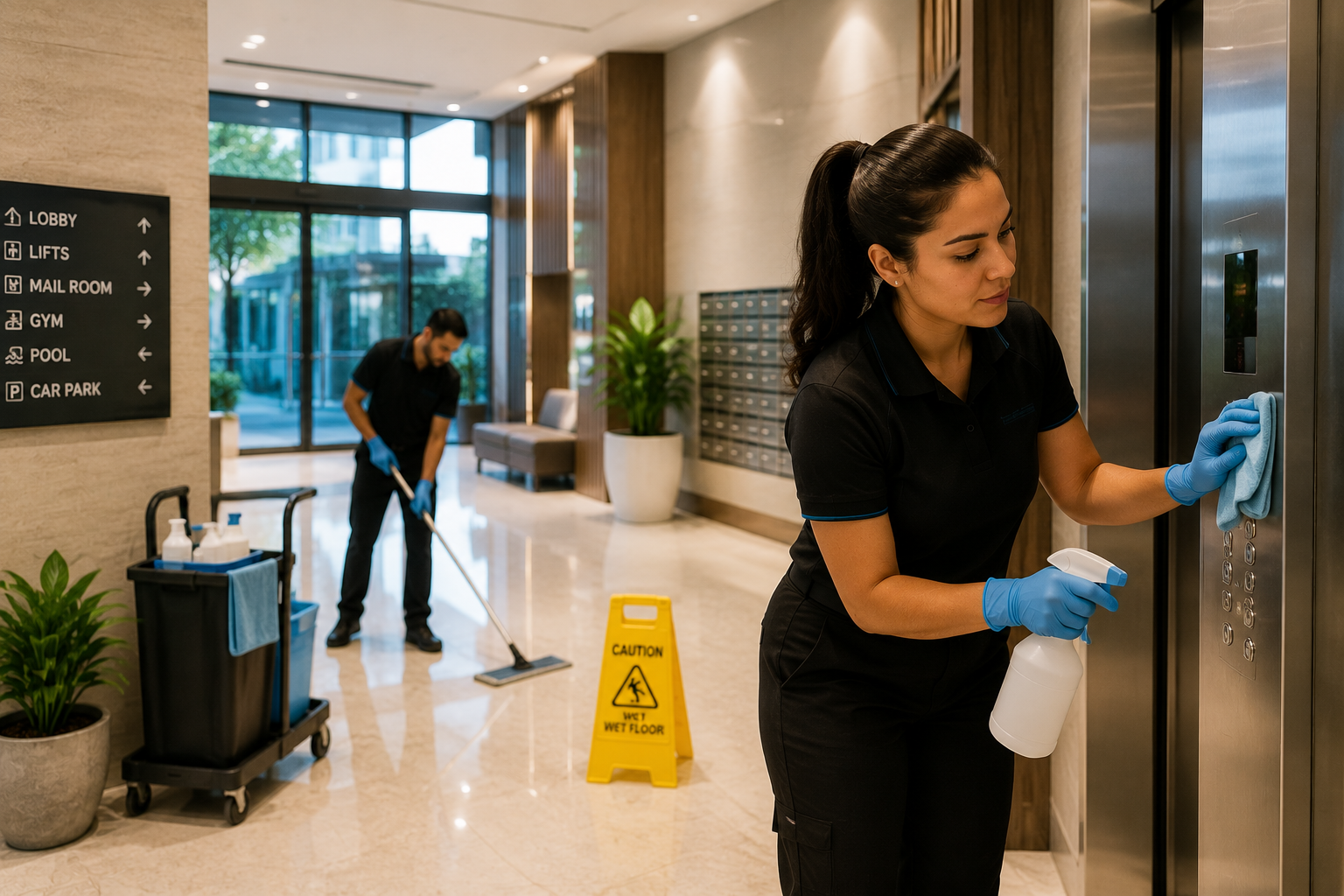
  • Lift interiors, buttons, handrails, and door tracks
  • All stairwells and fire escape landings
  • Car park floors, columns, and painted line areas
  • Bin rooms and waste compactor surrounds
  • Mail and parcel areas
  • Garden edges and paths adjacent to common entrances
  • Pool surrounds, gym common areas, and shared BBQ zones (where applicable)
  • External signage, letter boxes, and intercom panels

Commercial strata buildings add loading dock areas, shared bathroom facilities, fire stair corridors between tenancies, and sometimes roof access points depending on the scheme.

The one thing strata cleaning does not cover is anything inside a private lot. That boundary matters because it affects both the scope of work and who pays for it.

How often should strata common areas be professionally cleaned?

There is no single legal frequency set out in the Strata Schemes Management Act 2015 NSW, but owners corporations do have an obligation to keep common property in a reasonable state of repair and cleanliness. In practice, most Sydney building managers translate that into a cleaning schedule based on building size and resident numbers.

Building Type Standard Frequency October to February (Summer)
Small block (under 20 lots) 2x per week 3x per week
Medium residential (20–60 lots) 3x per week 4–5x per week
Large residential (60+ lots) 5x per week Daily
Commercial strata Daily Daily + mid-week bin room focus
Mixed use (retail + residential) Daily Daily + entry mat replacement

Summer foot traffic in Western Sydney buildings increases significantly from October through February. More people using the lift, more dust brought in through lobbies, and bin rooms filling faster all push towards a higher cleaning frequency than what might work in winter. If your current contract was written in June, it is worth reviewing it before December.

Who is legally responsible for strata cleaning in NSW?

The owners corporation is responsible. Under the Strata Schemes Management Act 2015 NSW, the owners corporation must properly maintain and keep in good repair the common property of the strata scheme. Cleanliness of shared areas falls squarely within that obligation.

The strata manager, if the scheme has appointed one, coordinates that responsibility on behalf of the owners corporation, but the legal duty stays with the owners corporation itself. Individual lot owners are not responsible for cleaning common areas unless the scheme’s by-laws specifically assign a shared area to a particular lot.

What this means practically: if a resident makes a complaint to NSW Fair Trading about unclean common property and you cannot produce cleaning records showing the work was done, you are exposed. That is why a written post-service record from your cleaner matters more than most strata managers realise.

What should a strata cleaning checklist actually include?

A professional strata clean covers more than a quick vacuum of the lobby carpet. Here is what should be completed on every scheduled visit and what gets added in the summer months.

Every visit:

  • Lobby floors swept and mopped with TGA-listed disinfectant
  • Lift interior mopped, mirrored surfaces wiped, buttons and handrails sanitised
  • All stairwells swept and spot mopped
  • Bin room hosed or swept and odour-treated
  • High-touch surfaces hit: door handles, intercom buttons, letterbox areas
  • Car park entrance swept

Added from October to February:

  • HVAC vent covers in common corridors dusted (relevant under AS/NZS 3666, the standard covering biological contamination in air handling systems)
  • Entry mats deep-cleaned or replaced more frequently
  • Lift door tracks cleared of summer dust and grit build-up
  • Garden-adjacent lobby areas swept more frequently due to increased foot traffic

Mercy Property Care provides a written post-service record after every visit confirming what was cleaned, what products were used, and anything flagged for follow-up. For strata managers preparing for levy disputes, insurance claims, or NSW Fair Trading complaints, that documentation can be genuinely useful.

What should I look for when hiring a strata cleaning company in Sydney?

The basics are non-negotiable: the cleaner should carry at least $20M public liability insurance, use police-checked staff, and provide written records after every visit. Most strata managers are surprised how many operators do not do all three.

Beyond that, worth asking:

  • Do they adjust their scope and frequency for summer without needing to be asked?
  • Can they service the full building, lobby, car park, bin room, pool surround, or just the internal corridors?
  • Do they use TGA-listed disinfectants on shared touch points, or general-purpose cleaning products?
  • Are they familiar with the Strata Schemes Management Act 2015 NSW and what “reasonable maintenance” actually means for common property?

If you are in Parramatta, Blacktown, Penrith, Castle Hill, or anywhere across Western Sydney, you can see exactly what a professional strata cleaning service in Sydney covers, get an honest picture of commercial cleaning costs for strata buildings, or book a free site assessment for your building before your next AGM.

FAQ

Q: What is included in a strata clean in Sydney?
A: A professional strata clean covers all common property areas: lobbies, lifts, stairwells, bin rooms, car parks, mail areas, and shared outdoor spaces. It does not include anything inside a private lot. Under the Strata Schemes Management Act 2015 NSW, the owners corporation is responsible for keeping all common property in a clean and reasonable condition. A proper strata cleaner will provide written records after every visit confirming what was done.

Q: How often should a strata building be professionally cleaned?
A: It depends on building size and foot traffic. A small block under 20 lots can typically manage with 2 to 3 professional cleans per week. A large residential building with 60 or more lots usually needs daily cleaning. During Sydney’s summer months from October through February, most buildings should increase their frequency by at least one additional visit per week to manage the higher foot traffic and dust brought into lobbies and stairwells.

Q: Who pays for strata cleaning, the owners corporation or individual owners?
A: The owners corporation pays for strata cleaning from the administrative fund, which is funded by lot owner levies. Individual lot owners are not separately invoiced for common area cleaning. The strata manager typically organises and pays the cleaner on behalf of the owners corporation. If your levies are covering cleaning costs but the work is not being documented, ask your strata manager for written service records.

Q: Does Mercy Property Care handle strata cleaning across Western Sydney?
A: Yes. Mercy Property Care provides strata cleaning services across Parramatta, Blacktown, Penrith, Castle Hill, Seven Hills, and surrounding Western Sydney suburbs. Every clean includes a written post-service record, police-checked staff, TGA-listed disinfectants, and $20M public liability insurance. You can book a free building assessment before committing to a contract.

Getting strata cleaning right is mostly about knowing what the scope should be, making sure it is documented, and working with someone who understands both the building type and the legal obligations that sit behind it. If your AGM is coming up or your current contract is due for review, speaking with Mercy Property Care before you sign anything is a good starting point. Book a free site assessment here and get a proper recommendation for your building before summer arrives.

Written by Mercy Property Care, Strata and Commercial Cleaning Specialists, Western Sydney
Strata Cleaning Sydney, What Owners Corporations Must Demand from Their Cleaner in 2026

TL;DR

NSW strata law changed in April 2026. Owners corporations now need standard-format 10-year capital works fund plans, and building managers carry expanded maintenance duties under the updated NSW Strata Schemes Management Act 2015. For strata cleaning in Sydney, this means one thing practically: your cleaning provider must give you written records after every visit, not just show up and clean. Mercy Property Care provides compliant strata cleaning across Western Sydney with documented service records, consistent teams, and same-week availability.

Why strata cleaning in Sydney just got more complicated

Strata cleaning in Sydney has always needed more structure than a handshake and a monthly invoice. But since April 2026, the stakes for getting it wrong have increased.

Under reforms to the NSW Strata Schemes Management Act 2015, all owners corporations must now maintain 10-year capital works fund plans in a government-prescribed standard format. Those plans need to account for ongoing maintenance across the building, including common areas, lobbies, car parks, and shared amenities. Separately, building managers now carry expanded duties around safety and maintenance that came into effect in October 2025.

None of this creates new cleaning obligations overnight. But it does mean that when a strata committee, building manager, or Strata Community Association NSW auditor asks what cleaning was done and when, you need actual records, not a verbal confirmation from the cleaner who was here last Thursday.

A well-structured strata cleaning contract gives your committee exactly that. A poorly structured one leaves a gap in your capital works documentation that is awkward to explain.

What does strata cleaning actually cover in a Sydney building?

Strata cleaning covers the common areas that all residents and visitors use. These are the spaces that accumulate wear fastest and matter most to building presentation, resident satisfaction, and safety.

For most Sydney strata buildings, a proper strata cleaning program covers:

  • Building entrance and lobby: floors, glass panels, letterboxes, intercom surfaces, signage
  • Lifts: interior panels, buttons, flooring, ceiling vents, and door tracks
  • Stairwells and corridors on every level, including light fittings and handrails
  • Car parks: sweeping, line marking maintenance, drain covers, waste removal
  • Outdoor common areas: bin enclosures, garden path edges, pool surrounds where applicable
  • Gyms and shared amenity rooms: surface wipe-down, equipment areas, bathroom fixtures

Frequency matters. A lobby cleaned once a week in a 40-apartment building with residents coming and going daily is not being maintained, it is being reset. The right schedule depends on resident count, foot traffic, and building type.

How often should a Sydney strata building be professionally cleaned?

For most Western Sydney strata buildings in suburbs like Parramatta, Penrith, Blacktown, and the Hills District, a workable baseline looks like this:

Area Minimum frequency
Building lobby and entry 3 to 5 times per week
Lifts 3 to 5 times per week
Stairwells and corridors Weekly
Car park Fortnightly
Bin room Weekly
Gym or amenity room 2 to 3 times per week

Spring is the right moment to revisit this. Building committees that skipped an autumn or winter deep clean now have compacted lobby floors, lift interiors that need a proper wipe-down, and common bathroom grout that has darkened. October through November is the scheduling window before Christmas locks out contractor availability.

What should you ask a strata cleaning company before signing a contract?

This is where most strata managers discover whether a provider is set up for strata work or just handles offices and homes on the side.

Four questions that tell you what you need to know:

Do you provide written service records after every visit? This is the single most important question. A strata cleaning company working in Sydney should provide a post-service record specifying what was cleaned, which areas were covered, the products used, and the date. If they cannot do this as standard, they are not operating at the level your capital works plan documentation requires.

Can you give me a written scope of work before we start? You should know exactly what is being cleaned at what frequency before any money changes hands. A verbal scope is not a scope.

What Australian Standards do you work to for carpets and hard floors? The standard for commercial carpet cleaning is AS/NZS 3733:2021, which requires hot water extraction at 65 degrees or above. A provider who does not know this standard is probably not using it.

Do your staff hold police clearances and public liability insurance? For any building where residents live, this is a baseline. Ask to see the certificate. Minimum $20M public liability is the benchmark for strata cleaning contracts in Sydney.

Mercy Property Care provides written scope before every clean, documented service record after every visit, and carries full public liability insurance. The team services strata buildings across Western Sydney as part of the same commercial cleaning program that covers offices and medical facilities.

Does NDIS apply to strata environments?

Sometimes, and it matters when it does.

If your strata building includes residents who are NDIS participants, or if the building houses a service provider that supports participants, the NDIS Practice Standards create an additional layer of environmental cleaning obligation. Registered NDIS providers must document infection control procedures, and cleaning evidence is auditable by the NDIS Quality and Safeguards Commission.

Mercy Property Care holds NDIS registration and provides NDIS cleaning services in Sydney separately from strata contracts. For mixed-use buildings where participants reside or receive services on-site, both the strata and participant cleaning can be structured under one provider relationship, which reduces the administrative overhead for support coordinators and building managers.

Frequently Asked Questions

Q: What is strata cleaning in Sydney and what does it include?

Strata cleaning in Sydney covers the common areas of residential or commercial strata buildings: lobbies, lifts, stairwells, corridors, car parks, bin rooms, and shared amenity spaces. It is distinct from individual unit or apartment cleaning. A professional strata cleaning company provides written service records after every visit, which are important for owners corporation documentation and capital works fund plan records under NSW strata law.

Q: How often should a strata building in Sydney be cleaned?

For most Sydney strata buildings, high-traffic areas like lobbies and lifts need cleaning three to five times per week. Stairwells and corridors work on a weekly schedule. Car parks are typically fortnightly. The right frequency depends on your building’s resident count, foot traffic, and any shared amenity spaces like gyms. A site assessment from a professional strata cleaning company gives you a schedule that matches the actual use of your building rather than a generic template.

Q: Do I need written service records from my strata cleaner?

Yes. From April 2026, NSW owners’ corporations must maintain 10-year capital works fund plans in a standard prescribed format. Cleaning is part of ongoing building maintenance, and documented service records are the evidence that maintenance was carried out. If your current strata cleaning provider does not supply written records after every visit, you have a gap in your compliance documentation. Ask your provider directly.

Q: How much does strata cleaning cost in Sydney in 2026?

Cost depends on building size, the number of common areas, access requirements, and how often cleaning occurs. For a small residential strata building under 20 apartments, a typical professional clean runs in the range of $150 to $350 per visit. Larger buildings with car parks, gyms, and multiple lift cores are scoped individually. Any provider quoting without a site inspection is guessing. Mercy Property Care provides free site assessments and written quotes before any contract is agreed.

Q: Can Mercy Property Care clean our strata building in Western Sydney?

Yes. Mercy Property Care provides strata cleaning services across Western Sydney including Parramatta, Westmead, Blacktown, Penrith, Castle Hill, the Hills District, and surrounding suburbs. Every clean includes a written service record. After-hours access is available to work around resident movements and building management requirements. Call 1300 973 856 to arrange a free site assessment.

Get strata cleaning that works for your building and your committee

Choosing the right strata cleaning company in Sydney comes down to documentation, consistency, and whether the provider actually understands what a strata environment requires. A residential building is not an office. A lobby used by 80 residents needs a different approach than a meeting room used once a week.

Mercy Property Care provides strata cleaning services across Western Sydney with written scope before every engagement, service records after every visit, and consistent teams who know your building. Spring scheduling is open now, before the pre-Christmas window closes.

Call: 1300 973 856

Or: 0257 407 688

Based in Toongabbie. Servicing Parramatta, Westmead, Blacktown, Penrith, Castle Hill, the Hills District, and all of Western Sydney.

Written by Mercy Property Care, Commercial and Strata Cleaning Specialists, Western Sydney.

Strata Cleaning Sydney – What Owners Corporations Must Demand from Their Cleaner in 2026

TL;DR

Strata cleaning in Sydney covers common areas including lobbies, lifts, car parks, stairwells, and shared amenities. Under the 2026 NSW strata reforms, Owners Corporations must ensure their cleaning contractor holds $20M public liability insurance, a valid Safe Work Method Statement, and Cm3 or equivalent contractor pre-qualification. Providers who pay referral commissions to strata managers must now be disclosed to lot owners – a rule that favours commission-free local operators. Mercy Property Care delivers strata cleaning across Western Sydney with all compliance documentation provided before first visit.

Why strata cleaning in Sydney changed in 2026 — and what it means for your building

Strata cleaning in Sydney is not the same conversation it was two years ago.

NSW Fair Trading rolled out strata management reforms across three stages – July 2025, October 2025, and April 2026 — that directly changed how cleaning contractors are selected, disclosed, and approved for common property work. For Owners Corporations in Parramatta, Blacktown, Penrith, and across Western Sydney, the reforms created a compliance gap that most buildings have not yet addressed.

Here is the short version: if your strata manager receives a referral fee or commission from your cleaning contractor, that arrangement must now be disclosed to lot owners, approved by the committee, and recorded in a register. Strata managers who engage commission-free cleaning providers — providers like Mercy Property Care — can do so without disclosure, without committee approval, and without a register entry. That is a meaningful administrative difference for any strata manager handling multiple buildings.

This shift means the criteria for selecting a strata cleaner in Sydney have expanded. Price and availability are still part of the decision. But compliance documentation, insurance, and commission transparency have become equally important — and lot owners now have the standing to ask questions they previously could not.

What does strata cleaning in Sydney actually cover?

Direct answer: Strata cleaning in Sydney covers all common property — the areas owned collectively by lot owners rather than individually. This includes lobbies, lifts, stairwells, car parks, bin rooms, mail areas, pool surrounds, gym facilities, rooftop terraces, and shared amenities.

The scope varies significantly between building types. A residential apartment block in Parramatta may need daily lobby cleaning and weekly car park maintenance. A mixed-use strata development in the Hills District with ground-floor retail may need multiple daily service windows across different zones.

The key areas in any strata cleaning scope in Sydney:

  • Lobby and entry areas — daily cleaning for most buildings with ground-floor foot traffic; every contact surface disinfected
  • Lifts — daily interior wipe and floor clean; weekly track and button-panel deep clean; monthly overhead diffuser clean
  • Stairwells and fire exits — weekly sweep and mop; handrail disinfection; emergency exit signage and landing areas clear
  • Car parks — weekly blow-down and mop of main traffic lanes; monthly full-bay sweep; oil spot treatment as required
  • Bin rooms and waste areas — weekly clean and disinfection; odour management; pest-prevention protocol
  • Pool and gym common areas — daily surface wipe; floor clean; consumable restocking (soap, hand sanitiser, towel bins)
  • Mail areas and common corridors — daily or 3× per week depending on traffic

A professional strata cleaner in Sydney should provide a written scope of work that specifies every area, the cleaning frequency, and the products used — before the contract starts.

What compliance does a strata cleaner in Sydney need to hold?

Direct answer: The minimum compliance standard for a strata cleaning contractor in Sydney is $20M public liability insurance, a site-specific Safe Work Method Statement (SWMS), and Cm3 or equivalent contractor pre-qualification.

The 2026 NSW strata reforms did not change the underlying safety and insurance obligations — those have been in place under the Work Health and Safety Act 2011 and the Strata Schemes Management Act 2015 for years. What changed is the transparency requirement around contractor selection, which now makes the following documentation easier to demand and verify.

Compliance checklist for a Sydney strata cleaning provider:

  • $20M public liability insurance — minimum AU standard for common property work; ask for a current certificate of currency, not just confirmation
  • Workers compensation insurance — mandatory for any provider with employees; self-employed sole traders are excluded by law, which creates risk for Owners Corporations
  • Safe Work Method Statement (SWMS) — site-specific document identifying hazards, controls, and the safe process for each cleaning task on your building
  • Cm3 pre-qualification — or equivalent third-party contractor management platform; confirms insurance, WHS compliance, and licences are current and verified
  • Police checks for all staff — required for buildings with residential tenants or where staff access private or secure areas
  • COVID-19 and infection control protocols — documented, not verbal; particularly relevant for buildings where NDIS participants or elderly residents live

Asking for this documentation before signing a cleaning contract is not excessive. Any provider who hesitates to supply it is not a provider whose staff you want in your building’s common areas.

How do the 2026 NSW strata reforms specifically affect cleaning contract selection?

Direct answer: The reforms require strata managers to disclose commissions or referral fees received from contractors, obtain committee approval where a conflict of interest exists, and maintain a disclosure register accessible to lot owners. Commission-free cleaning contractors can be engaged without triggering these requirements.

For Owners Corporations, this reform creates a straightforward filter when evaluating cleaning providers: ask your strata manager directly whether any arrangement exists between them and the cleaning company they recommend. Under the reforms, they are legally required to disclose it.

For cleaning providers, the reforms reward transparency. A strata cleaning company in Sydney that does not pay referral commissions is administratively simpler to engage — and is now required to say so, either explicitly or by the absence of any disclosure requirement.

Mercy Property Care does not pay referral fees to strata managers. Our strata cleaning contracts are quoted directly to the Owners Corporation or building manager based on scope, frequency, and compliance requirements — no commission arrangements, no required disclosures, no committee approval threshold triggered.

What should a strata cleaning schedule look like for a Sydney building?

Direct answer: Most Sydney strata buildings need a minimum of 3× weekly lobby cleaning, weekly lift and stairwell maintenance, and monthly car park and bin room deep cleaning — scaled up for buildings above 50 lots or with high foot traffic.

Frequency is one of the most poorly specified elements in Sydney strata cleaning contracts. Many contracts describe tasks without defining frequency, creating ambiguity when a lot owner questions whether their bin room has been cleaned this week.

Suggested minimum schedule for a 20–50 lot Sydney strata building:

Area Frequency Notes
Lobby and entry 3× weekly Daily for ground-floor retail or concierge buildings
Lifts 3× weekly Daily for high-rise or 100+ lot buildings
Stairwells Weekly Include handrails and landings
Car park Monthly sweep + weekly lane blow Oil spots treated as required
Bin room Weekly Disinfection included — not just sweeping
Pool and gym Daily Consumable restocking included in scope
Common corridors 3× weekly Mail areas included
Windows (external) Quarterly Specialist rope access for upper floors

Every item on this list should appear in your contract with a frequency specified. A contract that says “regular cleaning” without frequency is not a compliance document — it is a dispute waiting to happen.

For buildings in Parramatta, Blacktown, Penrith, the Hills District, and surrounding Western Sydney suburbs, Mercy Property Care provides strata cleaning services in Sydney with written scope, confirmed frequencies, and all compliance documentation supplied before the first visit.

What does Mercy Property Care’s strata cleaning service include in Western Sydney?

Mercy Property Care is a Western Sydney-based cleaning company operating from Toongabbie, led by Priyanka Kumar. The team provides strata cleaning across Parramatta, Blacktown, Penrith, Castle Hill, the Hills District, and surrounding suburbs — with commercial cleaning services covering the full range of commercial property types.

What distinguishes the Mercy Property Care strata service:

Consistent teams. The same people on the same building every visit. This matters in strata because staff who know the building spot anomalies — a lift malfunctioning, a bin room accumulation before collection day, a lobby light out — that a rotating team would miss.

Written scope and service records. Every strata cleaning contract includes a written scope of work with specified frequencies and a post-service record after every visit. For Owners Corporations who need to demonstrate due diligence at an AGM or respond to a lot owner complaint, these records matter.

No commission arrangements. Mercy Property Care does not pay referral commissions to strata managers. Contracts are quoted directly on merit — scope, frequency, compliance, and value.

NDIS registration. For mixed-use strata buildings where NDIS participants live or receive services, Mercy Property Care’s registered NDIS provider status means a single provider relationship can cover both strata common areas and individual participant home cleaning — reducing coordination overhead for building managers and support coordinators. For more on NDIS cleaning in Sydney, visit the NDIS cleaning service page.

Frequently Asked Questions

Q: What is strata cleaning in Sydney and what areas does it include? A: Strata cleaning in Sydney refers to professional cleaning of common property areas in strata-titled buildings — lobbies, lifts, car parks, stairwells, bin rooms, pool surrounds, gyms, and shared corridors. It does not include individual lot interiors. Cleaning frequency and scope should be specified in a written contract before work starts. Most Sydney strata buildings of 20+ lots require at least 3× weekly service across key common areas.

Q: What insurance does a strata cleaning company in Sydney need? A: The minimum is $20M public liability insurance with a current certificate of currency. Workers compensation insurance is also required for any provider with employees. Ask for both certificates before signing any strata cleaning contract in Sydney — not just verbal confirmation. A provider who cannot supply current certificates is not compliant with standard strata contractor requirements under NSW law.

Q: How did the 2026 NSW strata reforms affect cleaning contracts? A: The reforms, rolled out by NSW Fair Trading across July 2025, October 2025, and April 2026, require strata managers to disclose any commission or referral fee received from contractors to lot owners. If a conflict of interest exists, the engagement requires committee approval and a disclosure register entry. Strata cleaning providers who do not pay commissions to strata managers can be engaged without triggering these requirements — making them administratively simpler to use.

Q: How do I know if my strata building is getting a compliant clean? A: Request a copy of your cleaning contractor’s current public liability certificate, workers compensation certificate, site-specific SWMS, and Cm3 pre-qualification. Then request the last three service records showing what was cleaned, when, and by whom. If your contractor cannot supply all of these within 48 hours, your building is carrying compliance risk. Mercy Property Care supplies all of this documentation as standard — call 1300 973 856 to compare your current arrangement.

Q: Does Mercy Property Care service strata buildings across all of Western Sydney? A: Yes. Mercy Property Care provides strata cleaning across Parramatta, Blacktown, Penrith, Castle Hill, Toongabbie, the Hills District, Liverpool, and surrounding Western Sydney suburbs. Free on-site assessments include a written scope, compliance documentation package, and fixed pricing before any commitment. Same-week assessments are available — call 1300 973 856 or visit the cleaning services area page to check your suburb.

Get a Free Strata Cleaning Assessment for Your Western Sydney Building

The right strata cleaning contract for your building starts with a site inspection — not a phone quote. Mercy Property Care provides free, no-obligation on-site assessments for strata buildings across Western Sydney. Every assessment includes a written scope with specified frequencies, a full compliance documentation package, and fixed pricing before any commitment is made.

Book online: Strata Cleaning Services in Sydney →

Based in Toongabbie. Servicing Parramatta, Blacktown, Penrith, Castle Hill, Hills District, Liverpool, and all of Western Sydney.

Written by Mercy Property Care, Strata and Commercial Cleaning Specialists, Western Sydney.

Need Something To Be Cleaned?

Mercy Property Care Team Will Come To The Rescue!

Please fill out this form and we will get back to you shortly.