TL;DR:
NDIS registered providers in Sydney must meet NDIS Practice Standards Core Module 2 for infection control, including hospital-grade disinfectants, documented cleaning logs, and staff trained to NHMRC Guidelines. During flu season (May to October), frequency increases for high-touch surfaces and shared spaces. In Western Sydney, providers billing under line item 01_011_0120_1_1 must demonstrate cleaning compliance to pass NDIS Quality and Safeguards Commission audits. Mercy Property Care delivers this service to registered providers across Parramatta, Blacktown, and Penrith.
NDIS registered providers operating in Sydney must meet specific infection control standards year-round, but flu season raises the compliance bar. Under NDIS Practice Standards Core Module 2, providers are required to maintain environments that protect participants from preventable illness, and that obligation extends to how, how often, and with what products their premises are cleaned. If your cleaning contractor cannot supply documentation showing they meet these standards, your audit is at risk.
What do NDIS cleaning standards actually require in Sydney?
The NDIS Quality and Safeguards Commission sets the compliance framework. Core Module 2 requires that registered providers control infection risk in all participant-facing environments. In practice, that means:
- Hospital-grade TGA-listed disinfectants on contact surfaces
- Colour-coded microfibre cloths to prevent cross-contamination between toilets, kitchens, and living areas
- Written cleaning schedules specific to the facility layout
- Staff training records showing infection control competency
- Incident reporting procedures if a participant is exposed to a contaminated environment
For supported accommodation, community access facilities, and day programs in Western Sydney, these requirements apply regardless of whether cleaning is delivered in-house or outsourced. If you outsource, the responsibility to verify compliance stays with your organisation.
Why does flu season increase cleaning requirements for NDIS providers?
NSW Health issues a Respiratory Virus Advisory each year that directly affects how high-risk environments should be managed. NDIS participants often include people with compromised immune systems, respiratory conditions, or limited ability to self-isolate, which makes flu transmission in shared spaces a material safeguard risk.
During the May to October period, the Western Sydney Local Health District has historically recorded its highest respiratory presentation rates. For NDIS providers, that means:
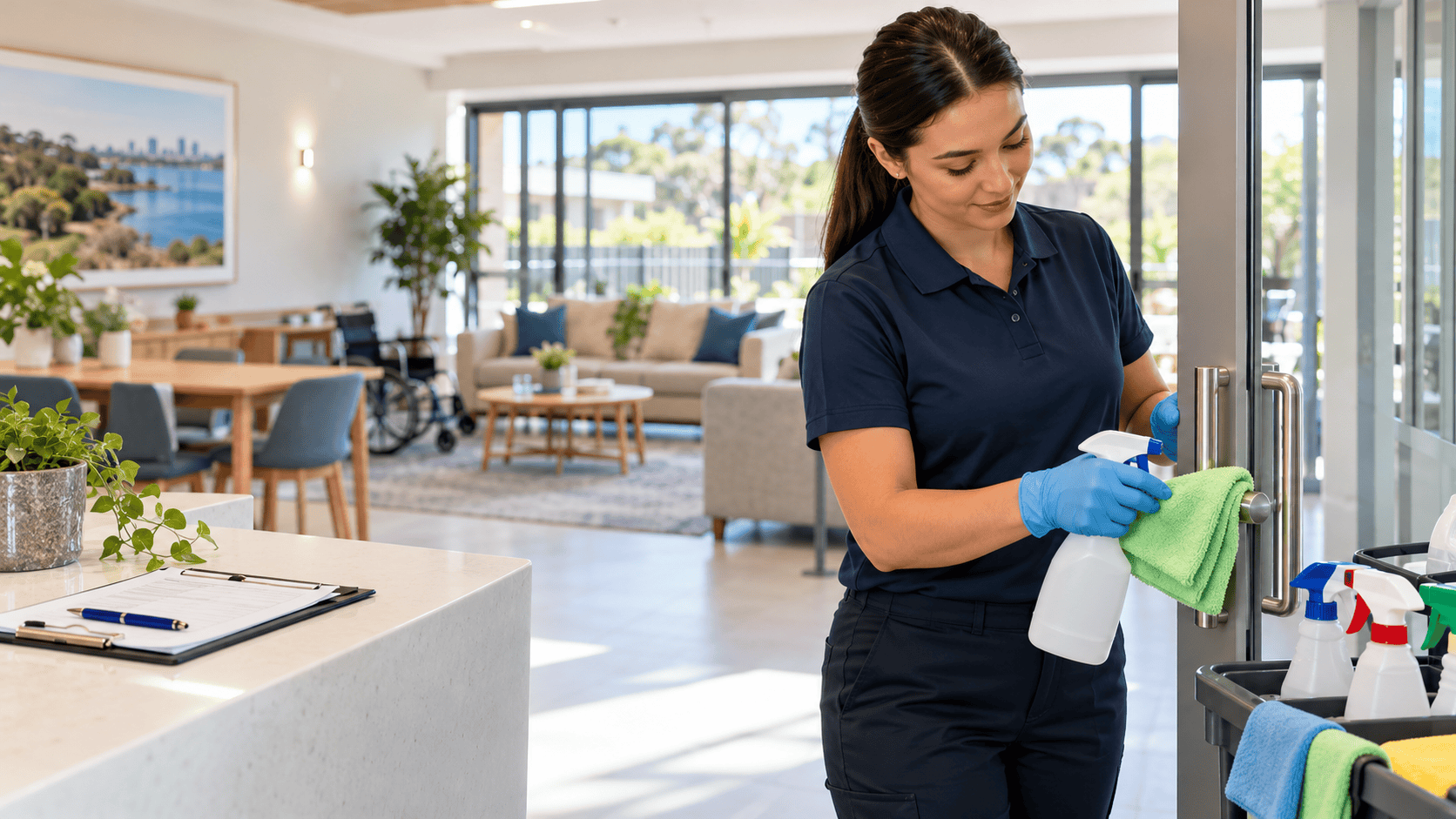
- High-touch surfaces (door handles, light switches, handrails, shared equipment) should be disinfected at least twice daily rather than once
- Shared bathrooms in supported accommodation require a minimum of two documented cleans per day during active outbreaks
- Any participant-facing soft furnishings should be reviewed for removability and laundering frequency
- Staff who clean must use appropriate PPE and follow AS/NZS 4187:2014 protocols for reprocessing reusable equipment
If your current cleaning provider does not adjust their schedule and documentation during flu season, that is a gap your Quality and Safeguards Commission auditor will find.
What cleaning line items apply under NDIS plans for this type of support?
Cleaning delivered as a support under an NDIS plan typically falls under line item 01_011_0120_1_1 (Daily Activities, Assistance with Self-Care Activities). Plan managers and support coordinators in Western Sydney often ask whether routine domestic cleaning qualifies, and the answer depends on participant need and how it is documented in the plan.
For provider organisations, the cost of maintaining compliant infection control cleaning across your facility is an operating overhead, not a participant line item. But for NDIS participants who receive in-home cleaning as a funded support, the provider delivering that service still needs to meet the same infection control standards.
Mercy Property Care supports both: direct participant services billed correctly under funded support, and facility cleaning contracts for registered providers across Parramatta, Blacktown, Penrith, Castle Hill, and Seven Hills. Learn more about our NDIS cleaning service in Sydney.
What should NDIS providers in Western Sydney look for in a cleaning contractor?
Not every commercial cleaner understands NDIS compliance. When assessing a contractor for your registered provider organisation, check for:
- Written infection control procedures aligned to NHMRC Guidelines
- TGA-listed product list available on request
- Colour-coded cleaning system documented in their methodology
- Staff with verified infection control training (certificate or statement of attainment)
- Willingness to supply signed cleaning logs that can be held as compliance evidence
- Experience working in supported accommodation, group homes, or day programs
A contractor who cannot produce documentation is a liability in an audit. Mercy Property Care supplies all of the above as standard, and our Western Sydney team works across Parramatta, Blacktown, Penrith, Castle Hill, and Seven Hills.
If you manage a medical or allied health facility alongside your NDIS services, see our medical centre cleaning standards page for how we handle clinical environments.
FAQ
Q: What is the difference between standard commercial cleaning and NDIS-compliant cleaning?
A: Standard commercial cleaning meets general hygiene requirements. NDIS-compliant cleaning meets NDIS Practice Standards Core Module 2, which specifies infection control protocols, product standards (TGA-listed hospital-grade disinfectants), documented cleaning schedules, and staff training requirements. Registered providers need the latter. Using a standard cleaner without these qualifications is a compliance risk during a Quality and Safeguards Commission audit.
Q: How often should high-touch surfaces be cleaned in NDIS facilities during flu season?
A: During the active flu season (May to October), high-touch surfaces including door handles, handrails, shared equipment, and light switches should be cleaned and disinfected at minimum twice per day. Western Sydney Local Health District guidance and NSW Health Respiratory Virus Advisories both support increased frequency during peak respiratory illness periods.
Q: Can an NDIS participant use their funding for cleaning services?
A: Yes, if it is documented in their plan as a daily activity support under line item 01_011_0120_1_1. The cleaning provider still needs to meet NDIS infection control standards regardless of whether the service is funded by the participant or delivered as part of a provider’s facility maintenance. For a breakdown of what is covered and what rates apply, see our NDIS cleaning rates guide for Sydney plan managers.
Q: Does Mercy Property Care work with NDIS registered providers across Western Sydney?
A: Yes. Mercy Property Care holds the qualifications, documented procedures, and infection control systems required to service NDIS registered providers across Parramatta, Blacktown, Penrith, Castle Hill, and Seven Hills. We supply signed cleaning logs and compliance documentation as standard. Contact us through our NDIS cleaning service page.
Choosing the right cleaning contractor for your NDIS registered organisation means more than finding someone with equipment. It means finding a provider who understands Core Module 2, adjusts their protocols during flu season, and can hand you documentation that holds up in a Quality and Safeguards Commission audit. Contact Mercy Property Care to discuss a cleaning schedule and compliance documentation package for your facility.
Written by Mercy Property Care, NDIS and Commercial Cleaning Specialists, Western Sydney